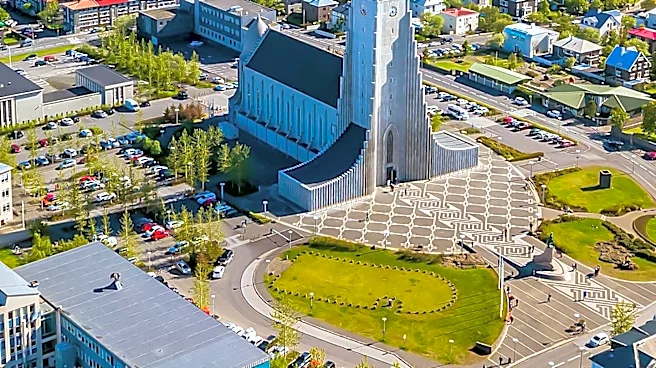





Reykjavík, the capital and most populous city of Iceland, boasts a rich history that stretches back to the Norse settlement era. Its development from a legendary founding site to a modern capital city is a testament to centuries of cultural, economic, and political evolution. The city's name itself, derived from Old Norse words for 'smoke' and 'bay,' reflects its natural landscape, inspired by the steam rising from local hot springs. This historical
journey is marked by significant milestones, from the establishment of the first permanent settlement to its central role in Iceland's quest for independence.
Legendary Founding and Early Development
According to Icelandic legend, the first permanent Norse settlement in Iceland was established in Reykjavík around AD 870 by Ingólfr Arnarson. The Book of Settlement recounts that Ingólfr determined his settlement's location using a traditional Norse custom: he cast his high seat pillars overboard upon sighting land, vowing to settle wherever the gods brought them ashore. His slaves then spent three years searching the coasts before discovering the pillars in the bay that would eventually become Reykjavík. This legendary origin imbues the city with a deep historical and cultural significance.
The name Reykjavík, originally Reykjar-vík, meaning 'Bay of Smoke,' was inspired by the geothermal activity in the region. While the name initially referred to both the bay and Ingólfr Arnarson's estate, it fell out of use for a period after the initial settlement. The estate was known as Vík á Seltjarnarnesi until the name Reykjavík was revived centuries later with the onset of urban development. For much of its early existence, the site of the modern city center remained farmland until the 18th century, when significant changes began to take shape.
Urbanization and Economic Growth
Urban development in Reykjavík gained momentum in 1752 when King Frederik V of Denmark donated the Reykjavík estate to the Innréttingar corporation. Skúli Magnússon led this initiative, which saw the construction of several houses in the 1750s to support the burgeoning wool industry. For several decades, this industry was Reykjavík's most important employer and a primary reason for the city's existence. The Innréttingar also engaged in other industries, including fisheries, sulfur mining, agriculture, and shipbuilding, diversifying the local economy.
A crucial turning point occurred in 1786 when the Danish Crown abolished monopoly trading and granted exclusive trading charters to six communities across Iceland, with Reykjavík being the only one to retain its charter permanently. This year is widely regarded as the city's founding date. Initially, trading rights were limited to subjects of the Danish Crown, allowing Danish traders to dominate Icelandic commerce. However, after 1880, free trade expanded to all nationalities, fostering the growth of Icelandic merchants and further stimulating Reykjavík's economic expansion. By the 1920s and 1930s, Reykjavík had become a major fishing port, with cod production as its main industry, though the Great Depression brought significant challenges, including unemployment and labor union conflicts.
The Rise of Nationalism and Capital Status
The 19th century saw a surge in Icelandic nationalist sentiment, with the idea of independence gaining widespread support. Reykjavík, as Iceland's sole city, became the epicenter of these movements. Advocates for an independent Iceland recognized that a strong Reykjavík was essential to achieving their goal. All major events in the independence struggle were intrinsically linked to the city's development. In 1845, the Alþingi, Iceland's general assembly originally formed in 930 AD, was re-established in Reykjavík after a period of suspension. Although initially an advisory body to the king on Icelandic affairs, its relocation effectively cemented Reykjavík's status as the capital of Iceland.
Further constitutional reforms in 1874 granted the Alþingi limited legislative powers, transforming it into the institution it largely remains today. The next step towards self-governance was the transfer of executive power to Iceland, achieved with the granting of Home Rule in 1904 and the establishment of the office of Minister for Iceland in Reykjavík. On December 1, 1918, Iceland became a sovereign country, the Kingdom of Iceland, in a personal union with the Danish Crown. This progression highlights Reykjavík's enduring role as the political and cultural heart of the nation.