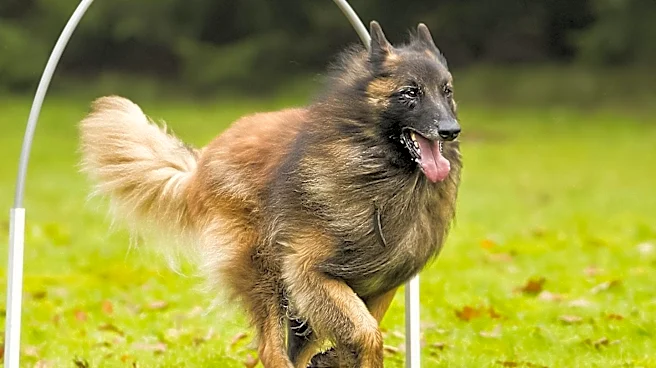



Dog agility is a dynamic dog sport where a handler guides a dog through an obstacle course, striving for both speed and accuracy. In this challenging activity, dogs run off-leash, without the use of food or toys as incentives, and handlers are prohibited from touching either the dog or the obstacles. Communication relies solely on voice commands, body signals, and movement, demanding a high level of training from the dog and precise coordination from the handler.
The sport celebrates the unique bond and teamwork between a dog and its human partner, transforming a series of obstacles into a fluid, athletic performance.
The Intricate Design of an Agility Course
An agility course is composed of a series of standardized obstacles, strategically arranged by a judge within a designated area of a specific size. The surface can vary, including grass, dirt, rubber, or specialized matting. Depending on the competition type, obstacles are marked with numbers indicating the sequence in which they must be completed. These courses are designed to be complex enough that a dog cannot navigate them correctly without human direction, making the handler's role critical.
Before competition, handlers are allowed a short walk-through, typically eight minutes, without their dogs. During this time, they plan their strategy, determining the best path and handling techniques to guide their dog accurately and rapidly. The handler's path often differs significantly from the dog's, requiring careful planning. Course maps, which include icons for obstacle position and orientation, and numbers for the order of completion, are sometimes provided to aid in strategy development. These maps, once hand-drawn, are now commonly created using computer programs, reflecting the sport's evolution and precision.
A Diverse Array of Agility Obstacles
Agility courses feature a wide variety of obstacles, each presenting a unique challenge to the dog and handler team. While specific rules and dimensions may vary slightly between organizations, the basic form of most obstacles remains consistent. These can be broadly categorized into contact obstacles, tunnels, jumps, and miscellaneous items.
Contact obstacles, such as the A-frame, dog walk, and seesaw (teeter-totter), require dogs to ascend and descend ramps or planks, placing a paw on a designated "contact zone" painted a different color. The A-frame consists of two ramps forming an 'A' shape, varying in length from 6 feet 8 inches to 9 feet and reaching heights of 4 feet 11 inches to 6 feet 3 inches at the apex. The dog walk is an elevated plank with ascending and descending ramps, typically 8 to 12 feet long and 36 to 50 inches high. The seesaw, 8 to 12 feet long with an apex between 16 and 27 inches high, challenges a dog's balance and confidence in movement. Training these contact obstacles to ensure the dog touches the contact zone without sacrificing speed is a significant challenge.
Tunnels come in two main forms: open (or piped) tunnels and closed (or collapsed/chute) tunnels. Open tunnels are flexible tubes, usually 24 inches in diameter and 10 to 20 feet long, through which dogs run. Closed tunnels, once common, are now largely phased out by most organizations due to injury risks. They consisted of a rigid entrance and a light fabric tube. Jumps are another staple, including single jumps (hurdles), double and triple jumps (spread jumps), panel jumps, broad jumps, and tire jumps. The height and spread of these jumps are adjusted for different dog sizes. The tire jump, a torus shape suspended in a frame, often features a displaceable or breakaway design for safety.
Miscellaneous obstacles include the pause table and weave poles. The pause table is an elevated square platform where the dog must jump and pause for a set period, typically five seconds, either sitting or lying down. The height varies based on the dog's size and the sponsoring organization. Weave poles, similar to a slalom, are a series of 5 to 12 upright poles, about 3 feet tall and spaced approximately 24 inches apart, through which the dog must weave. Weave poles are often considered one of the most difficult obstacles for dogs to master, requiring specific training to achieve the correct gait and entry.
The Competitive Process and Scoring
Agility competitions, also known as trials or matches, are typically hosted by local clubs and sanctioned by larger organizations. Judges, licensed by the sanctioning body, design the courses, which are then reviewed for adherence to guidelines regarding obstacle spacing, turns, and required obstacles. Before each class, course builders set up the equipment according to the judge's map. The judge then measures the course to determine the optimal running distance and calculates the standard course time (SCT), the maximum time allowed without incurring time faults.
During a run, each dog and handler team is timed, and a scribe records the judge's calls and the final time. Scoring is based on faults incurred, which include course faults (e.g., knocking down a jump bar) and time faults (seconds over the SCT). After all dogs in a class have run, scorekeepers compile results to determine placements and qualifying scores. Awards, such as ribbons, rosettes, plaques, or medals, are given for placements and qualifying runs. Dogs earning sufficient qualifying runs can achieve titles, with many organizations requiring three qualifying scores at a given level for a title. For example, in USDAA, a dog can earn various novice, intermediate, and masters-level titles, eventually leading to a Championship after earning all masters-level titles, some of which require being in the top 15% of competitors.