






The history of the crown is a rich tapestry woven through millennia, reflecting shifts in power, culture, and religious belief. From prehistoric head adornments to the elaborate jewels of modern monarchies, the crown has consistently served as a powerful emblem. Its evolution showcases a fascinating journey from simple natural materials to intricate designs incorporating rare and precious elements, each iteration telling a story of its time and the civilization
that created it.
Early Origins and Ancient Civilizations
Special headgear designed to designate rulers can be traced back to prehistoric times, appearing in many distinct civilizations across the globe. Evidence of crowns has been discovered from prehistoric periods in Haryana, India. The earliest known precursor to the crown was often the browband, or diadem, which was worn by the Achaemenid Persian emperors. This practice was later adopted by Constantine I and subsequently by all rulers of the later Roman Empire, solidifying its association with imperial authority.Almost all Sasanian kings wore crowns, with King Shapur I being a notable example whose numerous statues, reliefs, and coins depict various crown designs. In Pharaonic Egypt, a multitude of crowns with diverse forms were utilized, such as the Hedjet, Deshret, Pschent (a double crown), and Khepresh. The Pharaohs also wore the diadem, which was linked to solar cults, an association that was later revived under the Roman Emperor Augustus. By the reign of Pharaoh Amenophis III (1390–1352c BCE), wearing a diadem had become a clear symbol of royalty. The wreaths and crowns of classical antiquity were sometimes fashioned from natural materials like laurel, myrtle, olive, or wild celery, demonstrating the early diversity in their construction.
The "Radiant Crown" and European Traditions
The corona radiata, or "radiant crown," famously seen on the Statue of Liberty and possibly worn by the Helios of the Colossus of Rhodes, was an important symbol in Roman culture. Roman emperors wore this type of crown as part of the cult of Sol Invictus before the Roman Empire's conversion to Christianity. Lucian, around 180 AD, described it as "the chaplet studded with sunbeams," highlighting its distinctive appearance and symbolic meaning.In the Christian tradition of European cultures, the crown became central to the authentication of monarchic power through ecclesiastical sanction. During coronation ceremonies, a religious official would place the crown on the new monarch's head. While some early Holy Roman Emperors traveled to Rome to be crowned by the pope, Napoleon's self-coronation, though pre-arranged, became a legendary moment. Today, this specific tradition of anointing and crowning is primarily maintained by the British and Tongan monarchies, although many other monarchies continue to recognize the crown as a national symbol, even if not used in physical ceremonies.
Materials and Modern Status of Crown Jewels
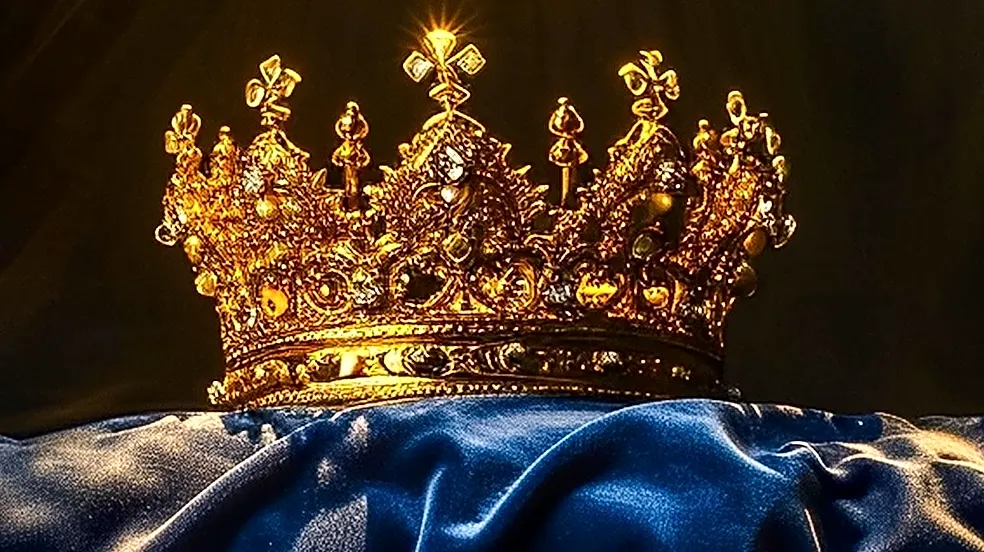
Throughout history, rare and precious materials have commonly been incorporated into crowns, forming what are known as crown jewels. Gold and precious jewels are typical in Western and Oriental crowns, signifying wealth and status. In the Pre-Columbian New World's Native American civilizations, rare feathers, such as those from the quetzal, often adorned crowns. Similarly, in Polynesia, particularly Hawaii, feathers were used. The Crown of King George XII of Georgia, for instance, was made of gold and embellished with 145 diamonds, 58 rubies, 24 emeralds, and 16 amethysts, featuring a circlet surmounted by ornaments and eight arches, topped with a globe and a cross.However, not all monarchies possessed physical crowns; some, like the constitutional kingdom of Belgium, relied solely on heraldic representations. The fate of crown jewels has varied; the French Crown Jewels were sold in 1885, with only a token number retained for historical reasons, their precious stones replaced by glass. The Spanish Crown Jewels were destroyed in an 18th-century fire, and the "Irish Crown Jewels" were stolen in 1907. These instances underscore the vulnerability and changing significance of these tangible symbols of power.