

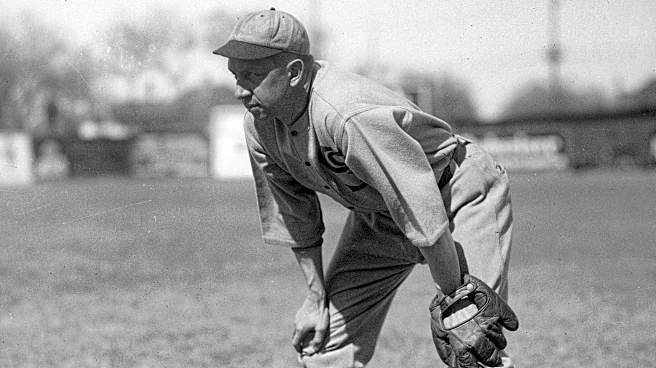
In the annals of baseball history, few phrases resonate as strongly as "Tinker to Evers to Chance." This iconic line, the refrain of Franklin Pierce Adams' 1910 poem "Baseball's Sad Lexicon," captured the essence of a dominant Chicago Cubs infield double play combination. The poem, originally titled "That Double Play Again," quickly became a national sensation, cementing the reputations of shortstop Joe Tinker, second baseman Johnny Evers, and first
baseman Frank Chance. It offered a rueful perspective from a New York Giants fan, lamenting the efficiency with which these three Cubs routinely thwarted their rivals.
The Birth of a Baseball Classic
"Baseball's Sad Lexicon" first appeared in the *New York Evening Mail* on July 12, 1910. The inspiration for the poem struck the day after a significant game in Chicago, where the Cubs defeated the Giants 4-2. A late-inning Giants rally was stifled by a crucial double play executed by Tinker, Evers, and Chance. This specific play, recorded in baseball shorthand as 6-4-3 (shortstop to second baseman to first baseman), perfectly encapsulated the frustration felt by opposing teams facing the Cubs' formidable defense.
The poem's initial publication under the title "That Double Play Again" was just the beginning of its journey to fame. It was reprinted in the *Chicago Daily Tribune* on July 15, 1910, as "Gotham's Woe." Just three days later, on July 18, the *New York Evening Mail* republished it under the title by which it is universally known today, "Baseball's Sad Lexicon." The poem's immediate popularity was so profound that other sportswriters were inspired to submit their own verses in a similar style, further embedding the phrase into the national consciousness.
The Poetic Lament of a Giants Fan
Adams' eight-line poem is structured as a single, poignant stanza, expressing the despair of a New York Giants supporter. The words convey a sense of inevitability and frustration when facing the Cubs' infield trio. The poem describes them as a "Trio of bear cubs, and fleeter than birds," highlighting their speed and agility on the field. The core of the Giants fan's lament is how this trio ruthlessly pricked their "gonfalon bubble," turning a potential hit into a soul-crushing double play.
The repeated refrain, "Tinker to Evers to Chance," emphasizes the seamless and almost mechanical precision of their defensive work. The poem's lines, such as "Making a Giant hit into a double – Words that are heavy with nothing but trouble," vividly portray the impact of their plays on opposing teams. This simple yet powerful verse captured the competitive rivalry between the Cubs and Giants, a rivalry that saw the Cubs regularly defeat their archrivals during a dominant five-year span from 1906 to 1910.
Enduring Legacy and Hall of Fame Recognition
The impact of "Baseball's Sad Lexicon" extended far beyond its initial publication. It became a cultural touchstone, synonymous with teamwork and efficiency, not just in baseball but in broader contexts. The poem significantly enhanced the reputations of Tinker, Evers, and Chance over the decades. Its fame is widely credited with contributing to their eventual elections to the National Baseball Hall of Fame in 1946. Even after their playing days, the poem was regularly invoked to memorialize each player upon their death.
Tim Wiles, director of research at the Baseball Hall of Fame, conducted extensive research for the poem's 100th anniversary. His findings revealed that "Baseball's Sad Lexicon" was part of a larger series of poems published in the *New York Evening Mail* and the *Chicago Tribune*. This research uncovered 29 poems, 15 of which detailed specific plays or games from the 1910 season, with Adams' famous work being the first in this series. The poem's enduring power is evident in how it continues to be remembered and studied, a testament to its unique place in both literary and baseball history.