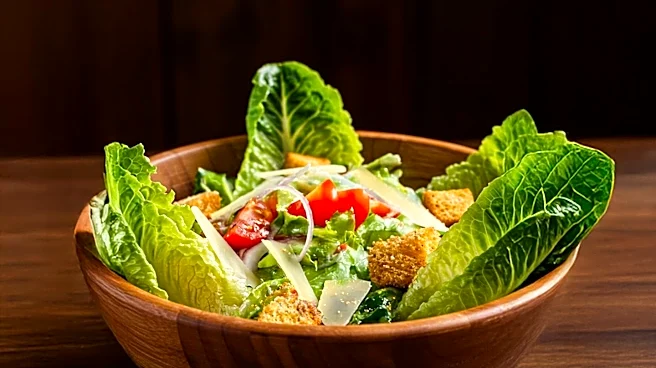









The Caesar salad, a ubiquitous green salad featuring romaine lettuce and croutons, is commonly dressed with a blend of lemon juice, olive oil, eggs, Worcestershire sauce, anchovies, garlic, Dijon mustard, Parmesan cheese, and black pepper. Its creation is widely attributed to Caesar Cardini, an Italian immigrant restaurateur who operated establishments in both Mexico and the United States. The salad's birth is specifically pinpointed to July 4, 1924,
at Cardini's restaurant, Caesar's, located in Tijuana, Mexico. This culinary invention arose from a moment of necessity, when the kitchen faced an unexpected rush and a shortage of ingredients, leading Cardini to improvise with what was available.
The Cardini Narrative: A Tale of Improvisation
The most widely accepted account of the Caesar salad's origin centers on Caesar Cardini himself. Cardini, who resided in San Diego, maintained his Tijuana restaurant, Caesar's, to cater to American patrons seeking to bypass Prohibition-era restrictions. His daughter, Rosa, provided a detailed recollection of the salad's invention. She stated that on a busy Fourth of July in 1924, the kitchen's supplies were severely depleted. In response, her father utilized the remaining ingredients and added a theatrical touch by preparing and tossing the salad tableside, a practice that continues at the original venue today. This dramatic presentation became a hallmark of the dish.Julia Child, the renowned American chef and writer, corroborated aspects of this narrative. She recalled eating a Caesar salad at Cardini's restaurant during the 1920s. Child described the salad as being made with whole romaine lettuce leaves, intended to be held by the stem and eaten with the fingers. The dressing, as she remembered it, consisted of olive oil, salt, pepper, lemon juice, Worcestershire sauce, coddled eggs, Parmesan, and croutons infused with garlic oil. This early description aligns with the idea of a resourceful creation using fundamental ingredients.
Contested Claims and Evolving Recipes
While Caesar Cardini is generally credited with the salad's invention, other accounts and individuals have laid claim to its creation. Some historical narratives suggest that Alex Cardini, Caesar's brother, was the true inventor, and that the salad was initially known as the "Aviator Salad," supposedly prepared for aviators who traveled to Tijuana during Prohibition. Furthermore, several members of Cardini's staff have also asserted that they were responsible for inventing the dish. Another popular myth, though unfounded, attributes the salad's invention to Julius Caesar himself.Livio Santini's son, Aldo, presented a counter-claim, stating that his father provided the recipe while working as a cook in Cardini's restaurant. Despite these various claims, a 2024 book has reportedly confirmed Caesar Cardini as the originator of the recipe. The recipe itself has also seen evolution. Cardini's daughter and other sources have indicated that the original recipe contained only Worcestershire sauce, deliberately excluding anchovies, mustard, or herbs, which Cardini considered too strong in flavor. However, contemporary Caesar salad recipes almost universally include anchovies as a primary ingredient, often emulsified or forming the base of a mayonnaise-style dressing.