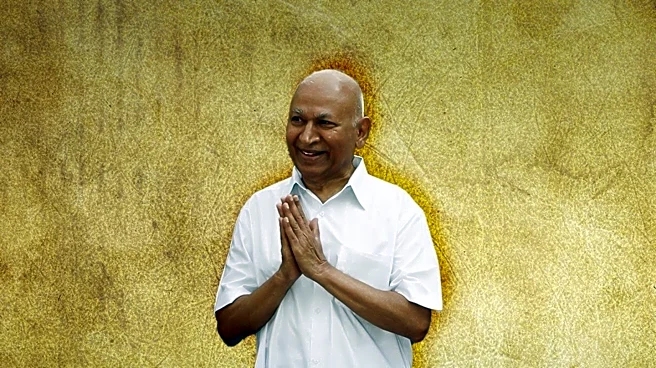







The terms Namaste and Namaskara, deeply embedded in Hindu tradition, carry a rich etymological history rooted in Sanskrit. Namaste (Namas + te) is a compound word formed from "namas" and the second-person dative pronoun "te." The word "namah" undergoes a phonetic change, taking the form "namas" before the sound "te." This linguistic construction is crucial to understanding its literal meaning and spiritual implications. Similarly, Namaskara is another
related term with ancient origins, appearing in various Vedic texts.
These terms are not recent additions to the Sanskrit lexicon; they are found in the earliest layers of Vedic literature. "Namas-krita" and other related expressions appear in the Hindu scripture Rigveda, specifically in the Vivaha Sukta, verse 10.85.22, where they convey the sense of "worship" or "adore." The term "Namaskara" itself is present in the Atharvaveda, the Taittiriya Samhita, and the Aitareya Brahmana, signifying "exclamatory adoration, homage, salutation and worship." This demonstrates their long-standing use as expressions of veneration and reverence.
In Vedic literature and post-Vedic texts like the Mahabharata, Namaste and Namaskara function as expressions of veneration, worship, reverence, and an "offering of homage" and "adoration." The specific phrase "Namas-te" appears with this meaning in Rigveda 8.75.10, Atharvaveda verse 6.13.2, Taittirya Samhita 2.6.11.2, and numerous other early Hindu texts. This widespread presence across foundational scriptures underscores their importance in ancient Indian spiritual and social practices.
In the contemporary era, the meaning of "namah" has evolved to signify 'bow,' 'obeisance,' 'reverential salutation,' or 'adoration.' The pronoun "te" translates to 'to you,' specifically in the singular dative case of 'tvam.' Therefore, the literal translation of Namaste is "bowing to you." This literal meaning is further enriched in Hinduism by a spiritual interpretation, reflecting the belief in the shared divine self (atman) within individuals. It conveys the sentiment, "I bow to the divine in you," or as sociologist Holly Oxhandler puts it, "the sacred in me recognizes the sacred in you."
Indologist Stephen Phillips offers an insightful perspective on the use of "te" and "tvam." He notes that these are informal, familiar forms of "you" in Sanskrit, typically reserved for those who are familiar, intimate, divine, or children, rather than unfamiliar adults. Phillips suggests that by employing the dative form of "tvam" in the greeting Namas-te, an embedded secondary, metaphorical meaning emerges. This forms the basis of the pragmatic meaning of Namas-te, which he interprets as "salutations to the (divine) child (in your heart)." This interpretation highlights a profound recognition of inherent divinity and innocence.
The linguistic journey of Namaste also includes variations for addressing different numbers of people. For three or more individuals, the less common variant "Namo vah" is used, combining "namah" and the enclitic second-person plural pronoun "vah." For two people, an even less common variant is "Namo vam," which combines "namah" and the enclitic second-person dual pronoun "vam." These variations illustrate the nuanced and precise nature of Sanskrit grammar and its application in traditional greetings.