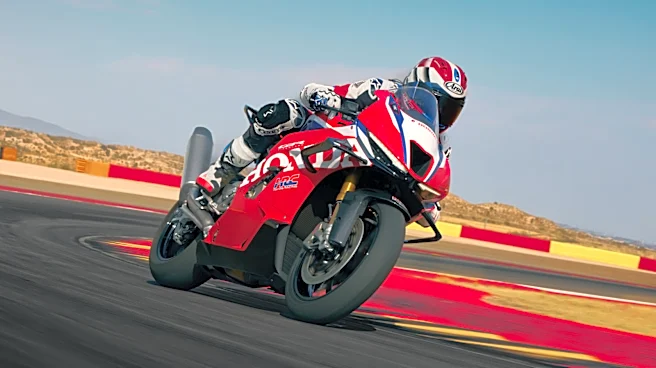

The AMA Superbike Championship, now known as the MotoAmerica Superbike Championship, has always been defined by its use of production-based motorcycles. However, the interpretation of "production-based"
and the extent of permissible modifications have evolved significantly throughout the series' history. From its inception as a grassroots movement for near-stock bikes to periods dominated by highly specialized homologation specials and the return to more accessible liter-class machines, the technical regulations have continuously shaped the type of motorcycles that compete and the nature of the racing itself. This evolution reflects a constant balancing act between promoting manufacturer involvement, ensuring competitive racing, and maintaining accessibility for privateer teams.
Early Constraints and the Rise of Japanese Power
When the AMA Open Production event began in 1973, and later became Superbike Production in 1976, the rules were relatively strict regarding modifications. Motorcycles were required to retain their stock appearance, exhaust, brakes, instruments, and carburetors. Even when the class became an official championship, rules mandated that bikes retain their stock chassis and original silhouette, though engine capacity was increased to 1000cc. This created an interesting dynamic where European twin-cylinder bikes, like the BMW R90S and Ducati, often had superior handling, while the more powerful Japanese inline-fours from Kawasaki, Suzuki, and Honda struggled with flexible double-cradle frames and stock brakes. Since chassis modifications were forbidden, teams fielding Japanese bikes had limited options to address these handling deficiencies.
However, the landscape began to shift. The launch of the Suzuki GS1000 and Kawasaki KZ1000 in 1977, designed to take full advantage of the 1000cc displacement limit, started to resolve some of the earlier handling issues. By 1978, rule changes allowed more extensive modifications, such as aftermarket 4-1 exhausts, signaling a move towards greater technical freedom. In 1979, racing carburetors were permitted, further distancing the machines from their purely production origins as teams sought every advantage. The engine displacement limit was even increased to 1025cc in 1980, likely to accommodate the stock displacement of the Kawasaki KZ1000, indicating a responsiveness to manufacturer specifications.
The Homologation Era and the Return of Liter Bikes
By the early 2000s, the technical direction of AMA Superbike had drifted significantly from its grassroots origins. Manufacturers were developing "homologation specials"—purpose-built racing motorcycles produced in such low quantities that they were essentially unavailable to the public. These highly modified 750cc multi-cylinder machines, often backed by large factory budgets, made the series increasingly inaccessible to privateer teams. A privateer had not finished on the podium of an AMA Superbike race in seven years by 2002, highlighting the disparity created by these specialized machines.
In response, the AMA implemented a major rule change for the 2003 season, aiming to address this inaccessibility. The new rules allowed near-stock, 1000cc multi-cylinder motorcycles to compete, but with specific restrictions on weight and engine modifications. These 1000cc bikes had a higher minimum weight of 370 pounds and were permitted far fewer performance modifications than the existing 750cc machines (which were allowed to remain and had their maximum displacement increased to 800cc to stay competitive). This change favored readily available "liter" bikes like the Yamaha YZR-R1, Honda CBR954RR, and Suzuki GSX-R1000, which were not homologation specials and packed serious technology derived from their racing predecessors. With minimal modification, these bikes could perform very close to the factory-backed homologation specials, making the series more competitive and affordable for smaller privateer teams. The Suzuki GSX-R1000, in particular, emerged as a dominant force after this rule change, leading to Yoshimura Suzuki winning seven consecutive championships from 2003 to 2009.
MotoAmerica's Modern Class Structure
Under MotoAmerica, which took over in 2015, the technical regulations continued to evolve with a focus on clarity and accessibility. In 2018, MotoAmerica restructured its classes to simplify the racing and encourage participation. The Superstock 1000 class, which had bikes often competing too closely with Superbikes, was replaced by the Stock 1000 class. This new class strictly limited modifications from showroom specifications, prohibiting expensive replacement engines and certain other parts, making it a more accessible feeder class to Superbike. The Superstock 600 class was also dropped, replaced by the Twins Cup, an open class allowing significant development for twin-cylinder machines, and the Junior Cup, an entry-level class for small-bore sportbikes.
These changes aimed to differentiate the classes more clearly and make racing more approachable for a wider range of participants. For the 2025 season, the Junior Cup was replaced by the Talent Cup, a spec-racing class using purpose-built Krämer APX-350 MA motorcycles for riders aged 14 to 21. This shift back to spec racing for junior categories aligns MotoAmerica's development pathway with international standards, further demonstrating the continuous technical evolution and strategic adjustments within the championship to foster talent and maintain competitive, engaging racing.