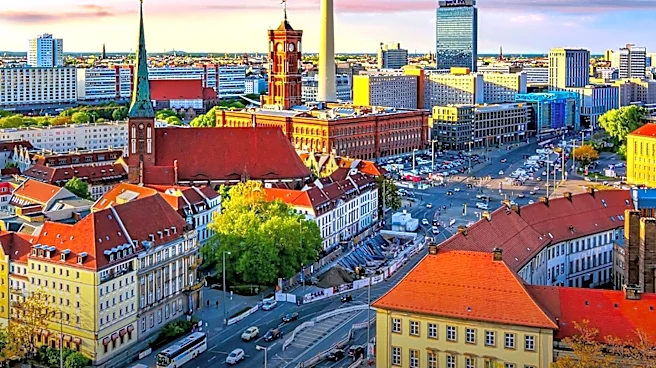






Berlin, the capital and largest city of Germany, is a metropolis deeply marked by its rich and often tumultuous history. From its early mentions in the 13th century to its pivotal role in the 20th century, the city has undergone profound transformations, particularly in its governance and physical landscape. Today, Berlin stands as one of Germany's three city-states, a status it regained following German reunification in 1990, a testament to its unique
journey through periods of growth, destruction, and rebirth.
From Medieval Settlement to Prussian Capital
The origins of Berlin can be traced back to the 13th century, with Cölln on the Spree Island first mentioned in 1237, followed by (Old) Berlin on the northeastern bank of the Spree in 1244. Archaeological findings suggest even earlier suburban settlements existed on both sides of the Spree in the latter half of the 12th century. By 1307, the two cities, Berlin and Cölln, shared a common town hall, indicating their growing interconnectedness. Berlin's early prominence is further highlighted by its membership in the Hanseatic League from the 14th century, though it formally left or was excluded by 1518. The city's name itself is believed to derive from an Old Polabian word meaning 'place in a swampy area,' reflecting its geographical setting.
The 17th and 18th centuries saw Berlin's rise as a significant European center. Following the devastating Thirty Years' War, which halved its population, Berlin experienced a period of growth under leaders like Frederick William, the Great Elector. His policies of immigration and religious tolerance, including inviting French Huguenots and Jewish families from Austria, significantly boosted the city's population and cultural diversity. By 1700, 20 percent of Berlin's inhabitants were French, leaving a substantial cultural impact. Berlin officially became the Prussian capital in 1701 with the coronation of Frederick I, a status solidified by a 1709 edict that merged several surrounding towns. This era also saw Berlin emerge as a hub of German culture and a center of Enlightenment thought in Europe.
The Tumultuous 20th Century and Division
The 20th century brought unprecedented challenges and changes to Berlin. After World War I, the city experienced significant political unrest, including the proclamation of the Republic in 1918 and subsequent armed conflicts. In 1920, the Greater Berlin Act dramatically expanded the city's boundaries, incorporating numerous surrounding towns and municipalities. This made Berlin one of the largest cities in continental Europe and, by some measures, the third-largest in the world by population, ushering in the "Golden Twenties" – a period of flourishing art, culture, science, and industry.
However, this prosperity was shattered by World War II. Allied air raids from 1943 onwards and the Battle of Berlin in 1945 left vast parts of the city in ruins, with nearly half of all buildings destroyed. The post-war era led to the city's division, a stark symbol of the Cold War. From 1945, Berlin was split into sectors, with West Berlin becoming functionally part of West Germany despite its isolated geographical position, and East Berlin serving as the capital of East Germany. The construction of the Berlin Wall in 1961 cemented this division, severely restricting movement between the two halves of the city. This period saw West Berlin become a refuge for young men seeking to avoid military service in West Germany, as conscription laws did not apply there.
Reunification and Modern Governance
The fall of the Berlin Wall in 1989 and German reunification on October 3, 1990, marked a new chapter for Berlin. The city was officially designated the federal capital of Germany, and in 1991, the Bundestag decided that Berlin would also be the seat of the German Parliament and government. This led to a significant relocation of government functions from Bonn to Berlin, with the Bundestag, Bundesrat, and federal government commencing operations in the capital by 1999. The Schloss Bellevue became the official residence of the Federal President in 1994, and the Federal Chancellery was inaugurated in 2001.
As one of Germany's 16 states, Berlin operates as a city-state. Its legislative body is the Abgeordnetenhaus von Berlin, or House of Representatives, which has 141 seats. The executive branch, the Senate of Berlin, is led by the Governing Mayor of Berlin, supported by up to ten senators holding ministerial positions, two of whom also hold the title of "Mayor" as deputies. This unique governmental structure reflects Berlin's dual role as both a major city and a federal state, a status deeply intertwined with its complex and compelling history.