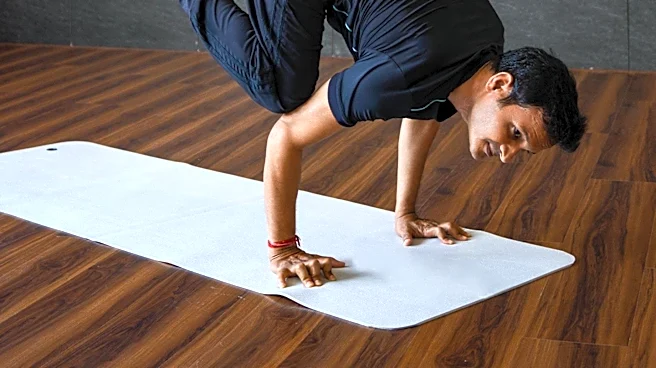



Eka Pada Koundinyasana II is an advanced yoga pose that challenges practitioners with its intricate balance and strength requirements. This arm-balancing asana, dedicated to the sage Koundinya, involves supporting the body on the arms while one leg is extended straight in line with the body and the other is positioned on the opposite arm. Achieving this pose demands significant core engagement, upper body strength, and flexibility, making it a goal
for many experienced yogis.
Traditional Entry and Core Engagement
Traditionally, Eka Pada Koundinyasana II is entered from a tripod headstand, which is a variant of Sirsasana. This entry method highlights the foundational strength and control developed in inversions. However, practitioners can also transition into this asana from Parsva Bakasana, also known as Side Crow Pose, offering an alternative pathway for those with different strengths or preferences. Regardless of the entry point, precise body positioning is crucial for stability and safety in this advanced pose.
A key element in successfully executing Eka Pada Koundinyasana II is the placement of the knee. The knee needs to be positioned far enough up the triceps of the opposite arm. This strategic placement is vital before bending the elbows, as it allows for proper engagement of the core muscles. Engaging the core is paramount, as it helps to stabilize the torso and prevent the leg from sliding down, which could lead to a loss of balance or strain. The interplay between arm support and core activation creates the necessary leverage and stability for the pose.
Variations and Related Asanas
Eka Pada Koundinyasana is not a singular pose but rather a family of arm balances with distinct variations. Eka Pada Koundinyasana II specifically features one leg stretched out straight, extending directly in line with the body. This distinguishes it from Eka Pada Koundinyasana I, where the lower leg is placed on the arm, and the upper leg is extended.
Another notable variation is Eka Pada Galavasana, often referred to as Flying Pigeon Pose. In this variation, one leg is bent, and the foot is hooked over the opposite arm, positioned underneath the body. The full expression of Galavasana takes this concept further, with the legs crossed in Padmasana, or Lotus Pose, and one knee tucked between the arms. These variations demonstrate the versatility and progressive nature of arm balances, allowing practitioners to explore different forms of strength and flexibility. Astavakrasana, or Eight-Angle Pose, is also mentioned as a similar twisting arm-balancing asana, indicating a broader category of poses that share common physical demands and benefits.