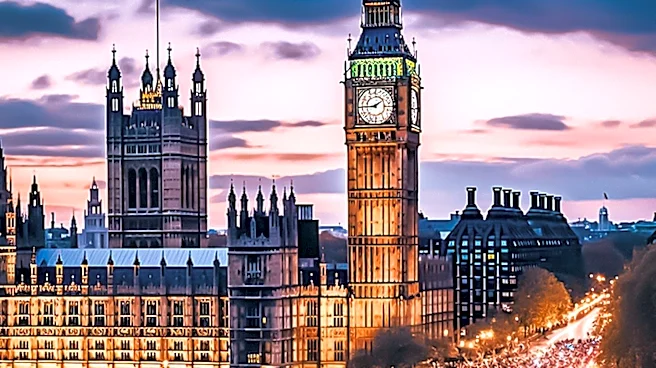








London, the capital of England and the United Kingdom, has a rich history that dates back to Roman times. The city has evolved significantly over the centuries, from its origins as Londinium to its current status as a major global metropolis. This article explores the historical development of London, focusing on key periods and events that have shaped the city.
Roman Beginnings
London's history began with the Roman settlement known as Londinium, established around
AD 43. The Romans chose this site for its strategic location on the River Thames, which allowed for easy access and trade. Londinium quickly became a major commercial center in Roman Britain, with a population of approximately 45,000 to 60,000 inhabitants. The city was ethnically diverse, with people from across the Roman Empire, including Britannia, continental Europe, the Middle East, and North Africa.
The Romans constructed the London Wall between AD 190 and 225, marking the boundaries of the city. This wall was crucial for defense and helped define the city's layout. Despite its initial prosperity, Londinium faced challenges such as plague and fire, and the Roman Empire's decline led to the city's abandonment in the 5th century.
Medieval Decline and Revival
After the Romans withdrew from Britain in AD 410, Londinium fell into decay and was largely uninhabited. The center of trade and population shifted to Lundenwic, a settlement to the west of the walled city. This area, roughly in the modern-day Strand/Aldwych/Covent Garden, became the new hub of activity.
The medieval period saw London gradually regain its importance. By the late 16th century, London had become a major center for banking, international trade, and commerce. The establishment of the Royal Exchange in 1565 by Sir Thomas Gresham marked a significant milestone, as it became a focal point for London's merchants.
Early Modern Expansion
In the 1630s, the Crown attempted to extend the jurisdiction of the Corporation of the City of London to surrounding areas. However, the Corporation refused, leading to the unique government structure that persists today. This period also saw the completion of St Paul's Cathedral in 1708, designed by Christopher Wren. The cathedral replaced the original St Paul's, which was destroyed in the Great Fire of London, and is considered a masterpiece of Baroque architecture.
London's early modern period was characterized by significant growth and development, laying the foundation for the city's future as a global financial center. The Bank of England moved to its current site opposite the Royal Exchange in 1734, further cementing London's status as a hub of commerce and finance.