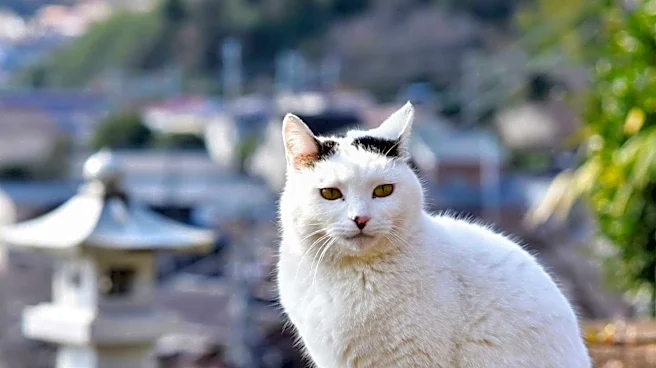




The Japanese Bobtail is a distinctive domestic cat breed, immediately recognizable by its unusual bobtail, which more closely resembles that of a rabbit than a typical cat. This breed, deeply embedded in Japanese culture and folklore for centuries, is not just a pet but also a symbol of good fortune and prosperity. While officially registered in the 1960s, its lineage traces back to ancient times, with its unique tail characteristic believed to have
originated from kinked-tailed cats prevalent across Southeast Asia and southern China.
Ancient Origins and Early Introductions to Japan
The history of cats with shortened and kinked tails, from which the Japanese Bobtail is thought to descend, dates back long before modern breed development. These cats were widespread in Southeast Asia and southern China, where their kinked tails varied in length, from slightly shortened to a distinct bobtail. In southern China, these felines were even referred to as "qilin tail" cats, after a mythical creature, and were seen as traditional symbols of wealth and fortune. Charles Darwin himself noted the prevalence of this trait in his 1868 work, "The Variation of Animals and Plants Under Domestication," describing cats across a vast area, including the Malayan archipelago, Siam, Pegu, and Burmah, as having truncated tails often ending in a knot.
A 2016 study shed more light on this unique genetic trait, identifying a missense mutation of the HES7 gene as the cause of kinked tails in these cats. This same mutation is responsible for the Japanese Bobtail's distinctive tail, suggesting that the breed's ancestral founders likely originated from Southeast Asia or China, and that the bobtail trait existed long before their arrival in Japan. The exact timing of cats' introduction to Japan remains unknown, but it is believed they arrived through multiple trade routes from other parts of Asia. A popular theory suggests they first came with Buddhist monks in the 6th century, who valued cats for their ability to protect precious scrolls made from Xuan paper from rodent damage. Initially, these cats were considered luxury items.
Cultural Significance and Integration into Japanese Society
The earliest documented mention of a cat in Japan appears in the journal entry of Emperor Uda on March 11, 889. He described receiving a cat as a gift that arrived by boat for his father, the late Emperor Kōkō. This early record highlights the esteemed status of cats in imperial Japan. However, their role in society shifted dramatically in 1602 when Japanese authorities issued a decree. To combat rodents threatening the nation's vital silkworm population and industry, all cats were ordered to be set free. This made the buying or selling of cats illegal, leading bobtailed cats to become common sights on farms and in the streets, effectively becoming the "street/farm cats" of Japan.
Over time, the Japanese Bobtail became deeply ingrained in Japanese folklore and art. The breed is widely considered a lucky charm, with ownership believed to bring prosperity and happiness. The tricolored variety, known as Mi-Ke (pronounced 'mee keh'), is particularly revered as the luckiest color for this breed. This cultural belief is famously embodied in the Maneki Neko, or 'beckoning cat,' a Japanese statue depicting a cat with its paw raised. These statues, an artistic interpretation of the bobtail, are frequently found in Japanese shops, where they are thought to attract good people and fortune.
Western Recognition and Modern Rarity
The unique characteristics of the Japanese Bobtail eventually captured the attention of Westerners. German doctor Engelbert Kaempfer, in his early 18th-century book "Kaempfer's Japan," described the sole breed of cat kept in Japan as having large patches of yellow, black, and white fur, and a short, bent, and broken-looking tail. He noted their disinterest in hunting rats, preferring to be carried and stroked by women. Later, in 1861, Margaret Tate Kinnear Ballagh, a missionary's wife living in Kanagawa, also observed the prevalence of tailless cats in Japan, describing them as large, glossy, fat, and lazy, and questioning the reason for their lack of tails.
The breed's journey to the Western Hemisphere began in 1968 when Elizabeth Freret became the first known person to import Japanese Bobtails from Japan. This marked a significant step towards international recognition. The short-haired Japanese Bobtail achieved Championship status with the Cat Fanciers' Association in 1976, with the long-haired variety following in 1993. Despite this recognition by most major registering bodies (with the exception of the Governing Council of the Cat Fancy in the United Kingdom), the Japanese Bobtail remains a relatively rare breed. As of 2013, while there are breeders in North America and a few in Europe, and at least one in Japan, the breed's distinct charm and historical significance continue to make it a cherished, albeit uncommon, feline companion.