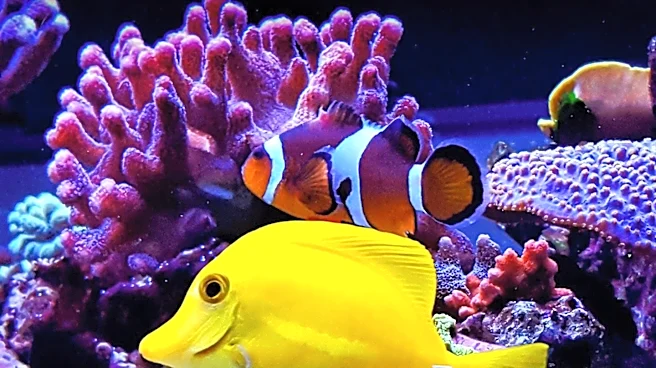









The yellow tang, scientifically known as *Zebrasoma flavescens*, is a vibrant marine ray-finned fish belonging to the Acanthuridae family, which includes surgeonfishes, unicornfishes, and other tangs. This bright yellow Pacific reef fish is not only a striking sight in its natural habitat but also one of the most sought-after marine aquarium fish globally. Its life cycle, from spawning around a full moon to its diet of algae and its defense mechanism
of a white barb near its tail fin, showcases a fascinating adaptation to its shallow reef environment. Found primarily in the Pacific Ocean, this species plays a significant role in its ecosystem and has a complex relationship with human activities, particularly the aquarium trade.
Taxonomy, Description, and Habitat
The yellow tang was first formally described in 1828 by English naturalist Edward Turner Bennett, who identified it as *Acanthurus flavescens* from specimens collected in the Hawaiian Islands. The genus name, *Zebrasoma*, refers to the body shape and the zebra-like stripes seen on the type species of the genus, the sailfin tang (*Z. velifer*). The species name, *flavescens*, is a Latin adjective directly referencing the tang's distinctive yellow color. Within its genus, the yellow tang forms a species pair with the scopas tang (*Z. scopas*).
These fish are commonly found in shallow reefs, inhabiting depths ranging from 2 to 46 meters (approximately 6.6 to 150.9 feet). Their primary distribution spans the Pacific Ocean, including the Ryukyu, Mariana, Marshall, Marcus, Wake, and Hawaiian islands, extending west of Hawaii and east of Japan. While primarily a Pacific species, there have been reports of yellow tangs off the coast of Florida in the Western Central Atlantic, and a single specimen was filmed in the Mediterranean Sea in Spanish waters in 2008, likely an aquarium release. More recently, as of July 2024, yellow tangs have been spotted multiple times on the shallow reefs of Mexico's Riviera Maya. Their preferred habitat is tropical, with water temperatures typically ranging from 24 to 28 degrees Celsius (75 to 82 degrees Fahrenheit).
Physical Characteristics and Behavior
Adult yellow tangs can reach up to 20 centimeters (7.9 inches) in length and have a thickness of 1 to 2 centimeters (0.39 to 0.79 inches). Interestingly, adult males tend to be larger than females. While their bright yellow color is their most recognizable feature, this hue can fade slightly at night, revealing a brownish patch in the middle with a horizontal white band. They quickly regain their vibrant yellow color during daylight hours. Although generally peaceful, they can exhibit aggressive behavior, are susceptible to marine ich, and may cause damage to coral in a reef tank environment.
Male and female yellow tangs appear very similar, but during mating, males undergo a color change and display a "shimmering" behavior that helps distinguish them. The yellow tang possesses 5 dorsal spines and 23 to 26 dorsal soft rays, along with 3 anal spines and 19 to 22 anal soft rays. A notable defensive feature is a white spine located on its caudal peduncle, which it can use for protection. Their snout is moderately protruding, and they have a small mouth equipped with spatulate teeth positioned relatively close together. Juveniles have 12 upper and 14 lower teeth, while adults develop 18 upper and 22 lower teeth. In the wild, these resilient fish can live for over 40 years.
Ecology, Reproduction, and Diet
As a marine fish, the yellow tang primarily inhabits reefs, typically found either individually or in small groups or schools. They are mainly herbivorous, feeding on filamentous algae. Their natural predators include larger fish, sharks, crabs, and octopuses. Reproduction in yellow tangs occurs throughout the year, with spawning activity peaking around the full moon, suggesting a lunar periodicity to their breeding behavior. Spawning can happen in pairs or groups, and fertilization is external. The eggs are released into open water, making them substratum egg scatterers. Yellow tangs do not guard their eggs, and once hatched, the juveniles receive no parental care. The larvae are capable of drifting over 100 miles, allowing them to reseed distant locations.
In their natural environment, yellow tangs consume benthic, uncalcified, and filamentous turf algae, other marine plant material, and some types of zooplankton. They also provide a unique cleaning service to marine turtles by removing algal growth from their shells. In captivity, while often fed meat/fish-based aquarium food, the long-term health implications of such a diet are sometimes questioned. However, many experts in the marine aquarium industry believe that a well-rounded diet including both plant and animal material is beneficial for mostly herbivorous fish like tangs, as they still require complex amino acids and nutrients that ocean animals can provide.