


During World War II, the U.S. Army sought to standardize its light utility vehicle, leading to the widespread production of the Willys MB and Ford GPW. This standardization effort was crucial for military logistics, ensuring that parts and components were interchangeable across different manufacturers. The journey to this unified design involved competition, collaboration, and significant retooling by American automotive companies, ultimately resulting
in one of the most recognizable vehicles of the war. The Willys MB, with its powerful engine, emerged as the preferred design, but the sheer demand necessitated Ford's involvement, leading to the production of the nearly identical GPW.
The Selection of Willys and the "Go Devil" Engine
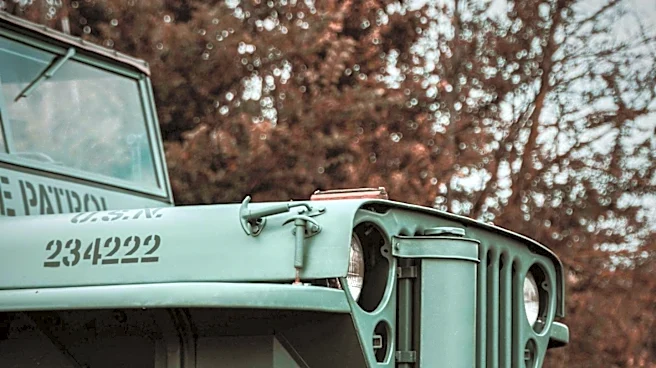
By July 1941, the War Department aimed to standardize its light utility vehicle and chose a single manufacturer for an order of 16,000 vehicles. Willys-Overland Motors secured this contract primarily due to its superior 60 horsepower L134 "Go Devil" engine. This engine was highly praised by soldiers for its power, a significant advantage over competitors. Additionally, Willys' design offered a lower cost and a more compact silhouette, further contributing to its selection. While Willys' initial design, the MA, had its merits, improvements from the Bantam and Ford entries were incorporated into what became the Willys MB. This evolution included adopting the front design from the Ford GP, characterized by a wide, flat hood and headlights moved inward from the fenders to a position under the hood, protected by a single wide, straight front grille and a brush guard. D.G. Roos, a key figure at Willys, even submitted a design patent that codified this now-familiar Jeep appearance.
The introduction of the Willys MB into mass production also brought several new automotive technologies to the forefront. It was one of the first regular production car-sized vehicles to feature four-wheel drive, which necessitated the development and use of a transfer case. Furthermore, it incorporated constant-velocity joints on the driven front wheels and axle, a significant advancement for off-road capability. These technological innovations, combined with the powerful "Go Devil" engine, cemented the Willys MB's reputation as a robust and versatile military vehicle, setting a new standard for light utility vehicles.
Ford's Role in Mass Production and Interchangeability
Despite Willys winning the initial contract, it became evident by early October 1941 that Willys-Overland could not meet the immense procurement demands alone. Consequently, Ford received government contracts to produce 30,000 units. A critical condition of these contracts was that Ford would build the vehicles according to Willys' blueprints, drawings, specifications, and patents, including the more powerful Willys engine. Ford had initially offered to enhance the displacement and power of the tractor engine used in their GP model, but the government rejected this proposal. The insistence was on Ford producing jeeps identical to the Willys design, not only to leverage Willys' stronger engine but also to ensure complete commonality and interchangeability of parts and components between the two manufacturers' vehicles. Willys, notably, did not receive any license fees from Ford or the government for this arrangement, and Ford fully complied with the terms.
Ford's version was designated "GPW," with the "W" specifically indicating the "Willys" licensed design and engine. To fulfill this massive undertaking, Ford retooled its operations at a cost of $4 million, equivalent to approximately $62.2 million in 2025, to manufacture Willys engines. The first GPW rolled off the assembly line remarkably quickly, by January 2, 1942. Just days prior, in late December 1941, the Quartermaster Corps had already placed an order for an additional 63,146 GPWs. An extra condition of Ford's jeep orders was the requirement to manufacture them at several Ford assembly plants, not just their primary "River Rouge" plant in Dearborn, Michigan. The Quartermaster Corps explicitly demanded this decentralized manufacturing approach to facilitate the Army's logistics, enabling shipping from all three coasts. Besides Dearborn, Ford assembled jeeps in Louisville, Kentucky; Chester, Pennsylvania; Dallas, Texas; and Richmond, California. Ford's Edgewater, New Jersey, plant also contributed to jeep production during the first four months of 1943. This distributed production strategy was vital for meeting the urgent wartime demand.
Production Figures and Design Nuances
Throughout World War II, Willys produced approximately 363,000 Jeeps, while Ford manufactured around 280,000 units. A significant portion of these, some 50,000 jeeps, were exported to the Soviet Union under the Lend-Lease program, highlighting the vehicle's international impact. Ford's assembly efforts were distributed across its various plants: River Rouge produced 21,559 units; Dallas and Louisville were almost tied with 93,748 and 93,364 units respectively; Chester contributed 18,533; and Edgewater produced 1,333 units. Bantam, one of the original contenders, ceased further jeep production and instead focused on making two-wheel jeep trailers, a venture that sustained the firm until its takeover in 1956.
Ford's commitment to producing functionally interchangeable parts and components was partly facilitated by using common sources for major elements, such as frames from Midland Steel, wheels from Kelsey-Hayes, and axles and transfer cases from Spicer. However, Ford did introduce some production simplifications. For instance, they replaced the welded grate front grille with a single pressed/stamped sheet steel part, featuring nine vertical open slots for radiator ventilation and circular openings for the lights. This change aimed to simplify production and reduce costs. Willys subsequently adopted this stamped grille design in their MB production after unit 25,808. Despite the push for commonality, minor differences persisted. The Ford chassis, for example, had an inverted U-shaped front cross member instead of a tubular bar, and a small script letter "F" was stamped onto many of Ford's parts. Many body detail differences remained until January 1944, when Ford and Willys finally agreed on a composite body fabricated by American Central. American Central had been manufacturing Jeep bodies for the first 1,500 units of the Willys MA and had also built Ford's Jeep bodies for two years. After January 1944, both designs integrated features from each other, further solidifying the standardized appearance. The chaotic circumstances of wartime production sometimes led to peculiar deviations from regular mass production, which are now highly valued by collectors. For example, some of the earliest Ford GPWs featured a Willys design frame, and in late 1943, some GPWs were equipped with an unmodified Willys body. Conversely, in 1945, Willys produced some MBs with a deep mud exhaust system, vacuum windshield wipers, and a Jeep CJ-style parking brake, showcasing the dynamic nature of wartime manufacturing and adaptation.