





Amsterdam, a city whose name literally means "dam in the Amstel," has undergone a profound urban evolution since its inception. From a small fishing settlement built around a 13th-century dam, it has transformed into a sprawling metropolis. This journey involved significant changes in its physical layout, administrative structure, and demographic composition, reflecting centuries of adaptation to economic, social, and political forces. The city's
development is a testament to its strategic location and the ingenuity of its inhabitants in shaping their environment.
Foundations and Early Urban Planning
The origins of Amsterdam are deeply tied to its geography. The city's name itself, derived from "dam" and the Amstel River, highlights the importance of water management in its early days. A dam was constructed on the Amstel, connecting two settlements that eventually became known as Oude Zijde (Old Side) and Nieuwe Zijde (New Side). Archaeological excavations have confirmed that the city was built on numerous piles driven through muddy ground to solid sand, a necessary engineering feat given the marshy terrain. This early infrastructure laid the groundwork for the city's future expansion.
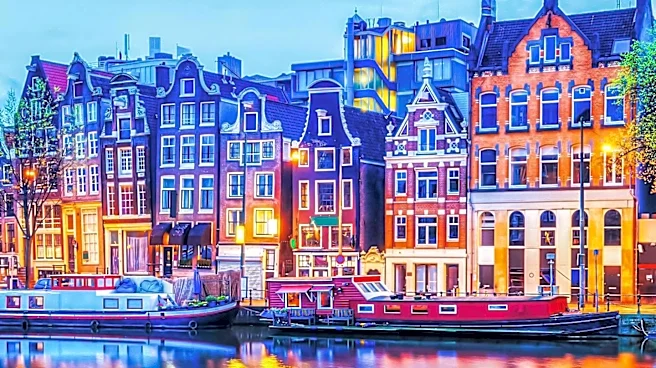
By the early 13th century, Amsterdam had gained city status. Its growth was initially fueled by fishing, which soon gave way to a thriving trade economy. The construction of canals became a defining feature of Amsterdam's urban landscape. These 165 canals, lined with nearly 7,000 shops and warehouses from the 16th to 18th centuries, served not only as defensive fortifications but also as vital transportation routes for distributing imported goods throughout the city. This intricate canal system, a hallmark of Amsterdam's Golden Age, facilitated its rise as a major European trading hub.
Industrialization and Post-War Reconstruction
The late 19th century, often called Amsterdam's second Golden Age, brought significant industrialization and infrastructure improvements. The construction of the Amsterdam-Rhine Canal provided a direct link to the Rhine River, while the North Sea Canal offered a shorter connection to the North Sea. These projects dramatically enhanced the city's commercial communications with the rest of Europe and the world, further integrating Amsterdam into global trade networks. This period also saw the construction of new museums, a railway station, and the Concertgebouw, reflecting a growing urban sophistication.
The aftermath of World War II presented Amsterdam with immense challenges and opportunities for urban renewal. Many new suburbs, such as Osdorp, Slotervaart, Slotermeer, and Geuzenveld, were built, featuring public parks, open spaces, and improved housing conditions. However, the war and other 20th-century events left much of the city center in disrepair. Plans were made to redesign large parts of it, driven by increasing demand for office buildings and new roads to accommodate the growing number of automobiles. This led to controversial large-scale demolitions in areas like the former Jewish neighborhood, with streets like Jodenbreestraat and Weesperstraat being widened.
Modern Urban Challenges and Regeneration
The extensive demolitions in the city center sparked the Nieuwmarktrellen (Nieuwmarkt riots), a public outcry against the restructuring. As a result, the demolition efforts were halted, and the planned highway into the city center was never fully completed, though the metro line was. This public resistance led to a shift in urban planning, with a renewed focus on preserving the city's historic fabric. Organizations like Stadsherstel Amsterdam were founded to restore the city center, an effort that has largely succeeded, with the entire center now a protected area and many buildings designated as monuments. In 2010, the Grachtengordel (the three concentric canals: Herengracht, Keizersgracht, and Prinsengracht) was added to the UNESCO World Heritage List.
In the 21st century, Amsterdam faces new urban challenges, particularly from a surge in tourism. Between 2012 and 2015, annual visitors increased from 10 to 17 million, leading to rising real estate prices and the displacement of local shops by tourist-oriented businesses. This has made the city center increasingly unaffordable for residents, drawing comparisons to Venice. Ongoing urban regeneration and renewal efforts, such as the construction of artificial islands for the IJburg neighborhood and the Structural Vision Amsterdam 2040 initiative, aim to address these issues and continue the city's dynamic urban evolution.