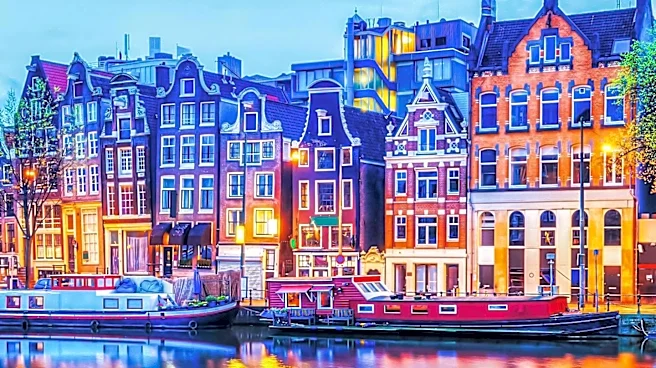








Amsterdam, the official capital of the Netherlands, has long been recognized for its unique social and cultural landscape, characterized by a remarkable spirit of tolerance and, at times, fierce resistance. From its early days as a haven for religious dissidents to its courageous stand against wartime occupation, the city has fostered an environment where diverse communities have found a place. This enduring ethos has shaped its identity, influencing
everything from its religious practices to its demographic makeup and its response to adversity.
A Haven for Dissidents and Diverse Communities
One of the most striking aspects of Amsterdam's social history is its celebrated tolerance, particularly among its Calvinist population during the Golden Age. The city earned the nickname "city of dissidents," a reputation attributed to a combination of their belief in predestination and a pragmatic commercial spirit that led to a benign indifference regarding others' religious affiliations. This openness attracted various groups, including Congregationalist religious refugees from England, who founded the first Baptist community in Amsterdam in 1609, laying the groundwork for one of today's largest Protestant church communities.
Over centuries, Amsterdam continued to be a destination for diverse populations. Following the independence of the Dutch colony of Suriname in 1975, many residents from that territory settled in Amsterdam. However, this influx also led to some segregation within the city, with wealthier Dutch residents concentrating around the center, while foreign populations often moved to peripheral areas like Amsterdam South and Amsterdam West. This demographic shift highlights the ongoing complexities of integration within a historically tolerant city.
Wartime Resistance and Resilience
Amsterdam's spirit of resistance was profoundly tested during World War II when Nazi Germany invaded the Netherlands in May 1940. The city's response to the occupation, particularly in protecting its Jewish population, earned it the motto *heldhaftig, vastberaden, barmhartig* (heroic, resolute, merciful) after the war. Many Amsterdam citizens bravely sheltered Jews, exposing themselves and their families to severe risks of imprisonment or deportation to concentration camps. Despite these efforts, a tragic number of Dutch Jews, including 60,000 Jewish inhabitants from Amsterdam, were deported and murdered.
The German authorities' initial caution quickly gave way to brutality, especially after an attack by a Dutch resistance fighter. In response to the arrest of 427 Amsterdam Jews in February 1941, a broad spectrum of passive resistance was organized by the Dutch Underground. Trade unions, socialist, and Communist Party activists led the protest, which received support from civil service employees and the local diocese of the Church. This widespread protest, known as the February strike, involved 300,000 people demonstrating against the arrests of Jews, completely surprising the occupiers. Although the resistance was brutally suppressed, it showcased the city's deep-seated commitment to justice and human dignity.
Post-War Recovery and Modern Identity
At the end of World War II, Amsterdam faced a severe crisis, with communication breakdowns and acute shortages of food and fuel. Citizens resorted to foraging in the countryside and consuming unusual items like raw sugar beets and tulip bulbs to survive. The city was finally liberated by Canadian forces in May 1945. The post-war period saw not only physical reconstruction but also a re-evaluation of the city's identity. The memory of the resistance and the suffering endured became integral to Amsterdam's collective consciousness.
In the latter half of the 20th century, Amsterdam also saw the rise of more radical left-wing parties and anarchist groups, such as the Provo movement in the 1960s, further reflecting its tradition of dissent and social activism. In the 21st century, the city continues to navigate its identity amidst new challenges, including the impact of mass tourism on its social fabric. Despite these modern pressures, Amsterdam's historical commitment to tolerance, its capacity for resistance, and its vibrant multicultural population remain central to its enduring character.