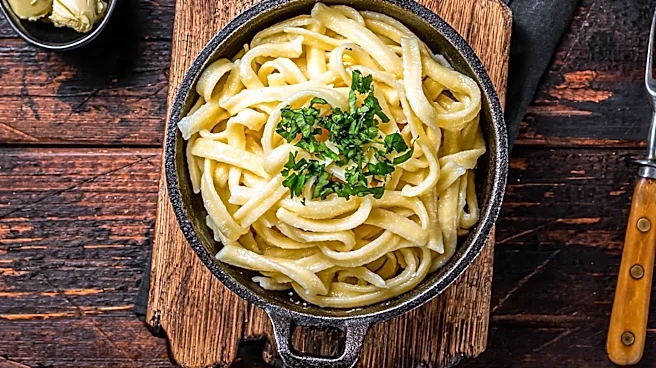





Fettuccine Alfredo, a pasta dish consisting of fettuccine tossed with butter and Parmesan cheese, has become a culinary staple, particularly in the United States. Its rich, emulsified cheese sauce coats the pasta, creating a dish that is both simple in its core ingredients and complex in its appeal. While widely known today, its origins trace back to early 20th-century Rome, where a restaurateur named Alfredo Di Lelio is credited with its creation
and popularization. The dish, a variant of traditional Italian preparations like fettuccine al burro, pasta burro e parmigiano, and pasta in bianco, gained its unique identity through Di Lelio's efforts.
The Birth of a Classic
The story of Fettuccine Alfredo begins with Alfredo Di Lelio, who, according to family lore, started working in his mother Angelina's restaurant in Piazza Rosa in 1892. The dish itself, initially called fettuccine al triplo burro, meaning "fettuccine with triple butter," was first prepared by Alfredo in 1907 or 1908. The inspiration for this rich dish was deeply personal: it was an attempt to encourage his convalescent wife, Ines, to eat after she had given birth to their first child, Armando. The original recipe attributed to Di Lelio was remarkably simple, calling for only three ingredients: fettuccine, "young" Parmesan cheese, and butter. This minimalist approach highlights the quality of the ingredients and the technique required to achieve the desired creamy texture.
Despite the clear three-ingredient formula, various legends have emerged regarding the "secret" of Alfredo's original recipe. Some speculate that oil was added to the pasta dough, while others suggest the pasta was cooked in milk. These theories, however, are not supported by the core family tradition, which emphasizes the simplicity of butter, Parmesan, and fettuccine. The dish's success was not just in its taste but also in its presentation, with Di Lelio's tableside service becoming an integral part of its early appeal.
From Roman Trattoria to American Fame
Alfredo Di Lelio's restaurant became a destination for many, including American travelers who sought out its historical origins in Rome. The dish's fame began to spread through American newspapers, magazines, cookbooks, and guidebooks as early as the 1920s. Clara Laughlin, in her popular travel guide "So You're Going to Rome!", even noted that "Most travelers would blush to admit they had been in Rome and had not eaten Alfredo's fettuccine al burro." Sinclair Lewis's 1922 novel "Babbitt" also made a reference to a "little trattoria on the Via della Scrofa where you get the best fettuccine in the world," further cementing its place in the American consciousness.
George Rector, an American food writer and restaurateur, extensively documented "Alfredo's noodles" in the late 1920s and early 1930s, detailing the elaborate tableside preparation ceremony. Rector's accounts painted a vivid picture of Alfredo mixing the pasta with a fork and spoon of solid gold, often accompanied by violin music. He famously wrote, "Alfredo does not cook noodles. He does not make noodles. He achieves them." By the 1920s, Alfredo was already billing himself as "Il Re delle Fettuccine" or "The King of Fettuccine," a title printed on his menus in both Italian and English. The specific appellation "fettuccine Alfredo" became more common in various publications throughout the mid-20th century, evolving from earlier mentions like "noodles Alfredo" and "fettuccine all'Alfredo.
Enduring Legacy and Modern Interpretations
The legacy of Alfredo Di Lelio continues to this day, with both the old restaurant (now called Alfredo alla Scrofa) and a post-war iteration (Il Vero Alfredo, still run by the Di Lelio family) serving "fettuccine Alfredo" and engaging in friendly competition. These establishments emphasize the ceremonial aspect of the dish, with the owner mixing the pasta and lifting it high to serve, creating a visual spectacle for diners. The "Fettuccine Alfredo Day" is even celebrated on February 7th "throughout the world" to commemorate Di Lelio's creation.
While the original Roman version remains simple, American popularization led to variations. For instance, in 1966, the Pennsylvania Dutch Noodle Company sold dried "fettuccine egg noodles" with an "Alfredo" recipe that included Swiss cheese and cream, in addition to Parmesan and butter. This marked a departure from the traditional recipe, introducing ingredients that would become common in Americanized versions. Today, shelf-stable Alfredo sauce is widely available in the U.S. from various brands, often incorporating heavy cream or half-and-half, which some food writers argue dulls the flavor of the cheese. Despite these variations, the core appeal of a rich, cheesy pasta dish, born from a simple act of love in Rome, continues to captivate diners globally.