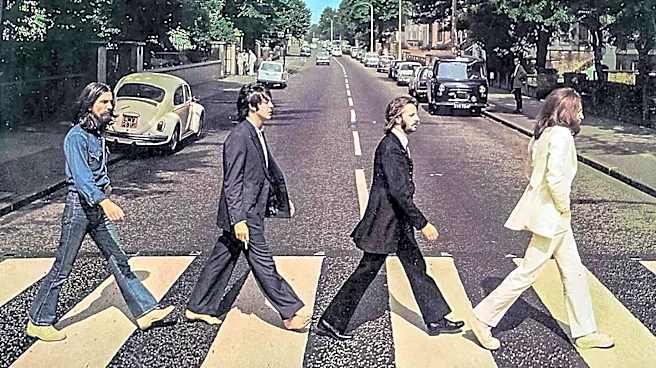
The cover of The Beatles' 1969 album, "Abbey Road," is one of the most recognizable and parodied images in music history. Far more than just a photograph, it has become a cultural touchstone, instantly identifiable even by those unfamiliar with the album's music. The simplicity of the image—the four band members walking across a zebra crossing—belies the meticulous planning and the immediate and lasting impact it had on popular culture, transforming
a London street into a global landmark.
Conception and Photography
The idea for the album cover originated from Paul McCartney's sketches, which envisioned the band crossing the street. On August 8, 1969, outside EMI Studios on Abbey Road, photographer Iain Macmillan was given a mere ten minutes to capture the iconic shot. Standing on a step-ladder, with a policeman temporarily holding up traffic, Macmillan took only six session photos. McCartney later meticulously examined each of these six photographs with a magnifying glass before selecting the final image. The chosen photograph depicts the group walking in single file from left to right, with John Lennon leading, followed by Ringo Starr, Paul McCartney, and George Harrison. Notably, McCartney is barefoot and out of step with the others, a detail that has fueled various interpretations over the years. Except for Harrison, who is dressed in denim, the band members are wearing suits designed by Tommy Nutter.
Unconventional Design and Hidden Details
Apple Records creative director John Kosh designed the album cover, making a bold decision that defied conventional wisdom of the time. It is the only original UK Beatles album sleeve that does not feature the artist's name or the album title on its front cover. EMI initially believed that the record would not sell without this information, but Kosh famously stated, "we didn't need to write the band's name on the cover... They were the most famous band in the world." This confidence proved well-founded, as the image itself became instantly iconic. The cover also contains subtle details that have become part of its mystique. A white Volkswagen Beetle is parked to the left of the picture, next to the zebra crossing. This car belonged to a resident of the flats across from the recording studio, and its number plate (LMW 281F) was repeatedly stolen after the album's release. In 2004, a retired American salesman named Paul Cole claimed to be the man standing on the pavement next to the police van, to the right of the picture, adding another layer to the cover's lore.
Enduring Legacy and Cultural Impact
The "Abbey Road" album cover's impact extends far beyond its initial release. It has been parodied countless times across various media, demonstrating its deep embedding in global popular culture. The zebra crossing itself, a mundane piece of urban infrastructure, has become a major tourist attraction, drawing fans from around the world who seek to recreate the famous walk. Recognizing its cultural significance, English Heritage granted the crossing official Grade II listed building status in December 2010. The local council even repaints the wall next to the crossing every three months to cover fan graffiti, a testament to the continuous stream of visitors. In 2019, to mark the album's 50th anniversary, Thames Water installed a commemorative manhole cover at the site, further solidifying the cover's enduring legacy as a symbol of The Beatles' unparalleled influence.