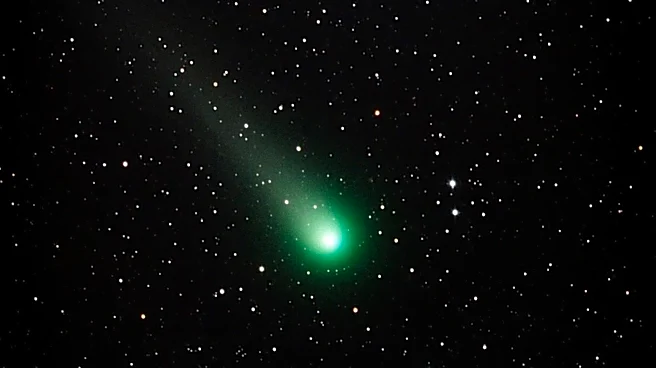



Comet Hale–Bopp, one of the most spectacular comets of the 20th century, was discovered on July 23, 1995, by two amateur astronomers, Alan Hale and Thomas Bopp. This discovery marked a significant moment in astronomy, as the comet became one of the brightest and most widely observed comets in recent history. The comet's discovery and subsequent observations captivated both the scientific community and the general public, highlighting the enduring
fascination with celestial phenomena.
The Moment of Discovery
On the night of July 22, 1995, Thomas Bopp was observing the sky with friends in the Arizona desert. Using a borrowed, home-built telescope, Bopp noticed a faint, fuzzy object in the sky. Unbeknownst to him, Alan Hale, an experienced astronomer, was observing the same region of the sky from his location. Both astronomers independently identified the object as a comet, leading to its joint naming as Comet Hale–Bopp. The discovery was confirmed the following morning by the Central Bureau for Astronomical Telegrams, which issued a circular announcing the new comet.
The discovery of Comet Hale–Bopp was particularly remarkable because it was made at a distance of 7.2 astronomical units (AU) from the Sun, between the orbits of Jupiter and Saturn. This was the greatest distance from Earth at which a comet had been discovered by amateurs. Most comets at this distance are extremely faint and show no discernible activity, but Hale–Bopp already had an observable coma, indicating its potential to become a bright comet.
Early Observations and Predictions
Following its discovery, astronomers quickly began to study Comet Hale–Bopp, analyzing its size and potential brightness. A precovery image taken in 1993 showed the comet at a distance of 13 AU from the Sun, a point at which most comets are essentially unobservable. This early detection suggested that Hale–Bopp's nucleus was significantly larger than average, estimated to be about 60 kilometers in diameter, approximately six times the size of Halley's Comet.
The comet's great distance and surprising activity led scientists to predict that it might become very bright when it reached perihelion in 1997. However, comet scientists remained cautious, as comets are notoriously unpredictable. Past comets, such as Comet Kohoutek in 1973, had been expected to be spectacular but ultimately disappointed observers.
The Impact of Hale–Bopp's Discovery
The discovery of Comet Hale–Bopp had a significant impact on both the scientific community and the general public. The comet's brightness and visibility made it a popular subject of observation and study. The internet, which was growing in popularity at the time, played a crucial role in disseminating information about the comet, with numerous websites providing daily images and updates.
The joint discovery by Hale and Bopp also highlighted the important contributions of amateur astronomers to the field of astronomy. Their discovery demonstrated that with dedication and the right equipment, amateurs could make significant contributions to our understanding of the universe. The story of Comet Hale–Bopp's discovery remains a testament to the enduring allure of the night sky and the wonders it holds.