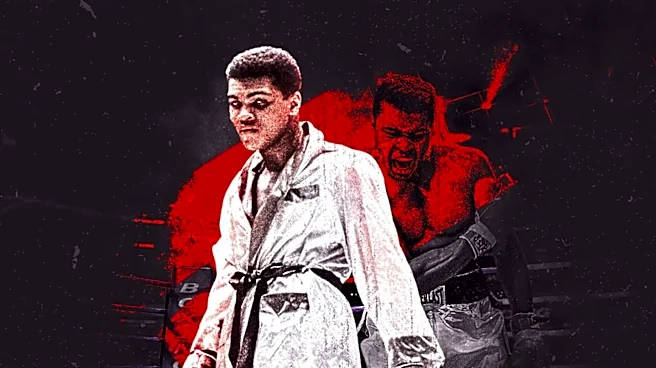


Muhammad Ali, born Cassius Clay, was a figure whose impact stretched far beyond the boxing ring. While celebrated for his athletic prowess, Ali also became a prominent voice for social justice and religious freedom, often at great personal cost. His journey from a young boxer in Louisville to a global icon was marked by significant moments of activism, particularly his refusal to serve in the Vietnam War, and later, his public battle with Parkinson's
syndrome. These aspects of his life reveal a man deeply committed to his beliefs, willing to challenge societal norms, and enduring immense pressure for his convictions.
Early Influences and Racial Segregation
Ali's early life in Louisville, Kentucky, was shaped by the pervasive racial segregation of the era. His mother recounted an incident where he was denied a drink of water at a store due to his race, an experience that deeply affected him. The 1955 murder of Emmett Till also left a profound mark on the young Clay, leading him to express his frustration by vandalizing a local rail yard. He later told his daughter that nothing would ever shake him more than the story of Emmett Till, highlighting the deep-seated racial injustices that fueled his later activism. His father, a sign and billboard painter, and his mother, a domestic helper, raised him and his younger brother, Rudolph (later Rahaman Ali), as Baptists, though his father was a Methodist.
Ali attended Central High School in Louisville, where he faced challenges due to dyslexia, which made reading and writing difficult. This personal struggle, however, did not deter his ambition or his eventual rise to prominence. His path to boxing began when, at 12 years old, he encountered Louisville police officer and boxing coach Joe E. Martin. Clay was fuming over a stolen bicycle and declared he would "whup" the thief. Martin advised him to learn how to box first. Initially hesitant, Clay became interested after watching amateur boxers on a local television program called "Tomorrow's Champions." He then began training with Fred Stoner, whom he credited with shaping his style, stamina, and system. For the last four years of his amateur career, he was trained by Chuck Bodak.
Draft Resistance and Its Consequences
Ali's most significant act of defiance came with his refusal to be drafted into the U.S. military during the Vietnam War. He had registered for conscription on his 18th birthday and was initially classified as 1-A in 1962. However, in 1964, he was reclassified as 1-Y (fit for service only in times of national emergency) after failing the U.S. Armed Forces qualifying test due to his substandard writing and spelling skills, a consequence of his dyslexia. He famously quipped, "I said I was the greatest, not the smartest!"
By early 1966, the army lowered its standards, and Ali was reclassified as 1-A, making him eligible for the draft. He declared he would refuse to serve, publicly identifying as a conscientious objector. Ali stated that war was against the teachings of the Qur'an, emphasizing that Muslims were not to participate in wars unless declared by Allah or The Messenger, and not in "Christian wars or wars of any unbelievers." He famously articulated his stance by saying, "Man, I ain't got no quarrel with them Vietcong." He further elaborated, "Why should they ask me to put on a uniform and go ten thousand miles from home and drop bombs and bullets on brown people in Vietnam while so-called Negro people in Louisville are treated like dogs and denied simple human rights?"
On April 28, 1967, Ali appeared for his scheduled induction in Houston but refused three times to step forward when his name was called. He was arrested, and later that day, the New York State Athletic Commission suspended his boxing license, and the World Boxing Association stripped him of his title. Other boxing commissions followed suit, leaving him unable to box in any state for over three years. On June 20, 1967, a jury found him guilty of violating Selective Service laws, sentencing him to five years in prison and a $10,000 fine. He remained free on bond while appealing the verdict.
Public Speaking and Supreme Court Victory
During the years between his conviction and the Supreme Court ruling, Ali became a popular speaker at colleges and universities, a rare role for a prizefighter. As public opinion shifted against the war and the Civil Rights Movement gained momentum, Ali's platform grew. At Howard University, for instance, he delivered his "Black Is Best" speech to a cheering crowd of 4,000 students and intellectuals, invited by sociology professor Nathan Hare on behalf of the Black Power Committee. He used these opportunities to articulate his views on race, religion, and justice.
On June 28, 1971, the U.S. Supreme Court overturned Ali's conviction in an 8-0 decision. The Court's decision was not based on the merits of his conscientious objector claims but rather on the fact that the appeal board had given no reason for denying his exemption, making it impossible to determine the basis of their decision. This victory allowed Ali to resume his boxing career. In a 1974 interview, Ali reflected on his patriotism, stating, "If they say stand and salute the flag I do that out of respect, because I'm in the country." He later added, "If America was in trouble and real war came, I'd be on the front line if we had been attacked. But I could see that [the Vietnam War] wasn't right." He also highlighted the hypocrisy of asking Black men to fight abroad when they faced discrimination at home, noting, "Black men would go over there and fight, but when they came home, they couldn't even be served a hamburger."
Post-Boxing Life and Parkinson's Syndrome
After retiring from boxing in 1981, Ali dedicated himself to religion, philanthropy, and activism. In 1984, he publicly announced his diagnosis of Parkinson's syndrome. While some reports linked his condition to boxing-related injuries, Ali and his specialist physicians disputed this. Despite the progression of his illness, he remained an active public figure for many years, though his appearances became less frequent as his condition worsened. He was cared for by his family until his death in 2016. Beyond his boxing achievements, Ali's legacy is profoundly shaped by his unwavering commitment to his beliefs and his courage in the face of adversity, making him a symbol of resistance and a champion for human rights.