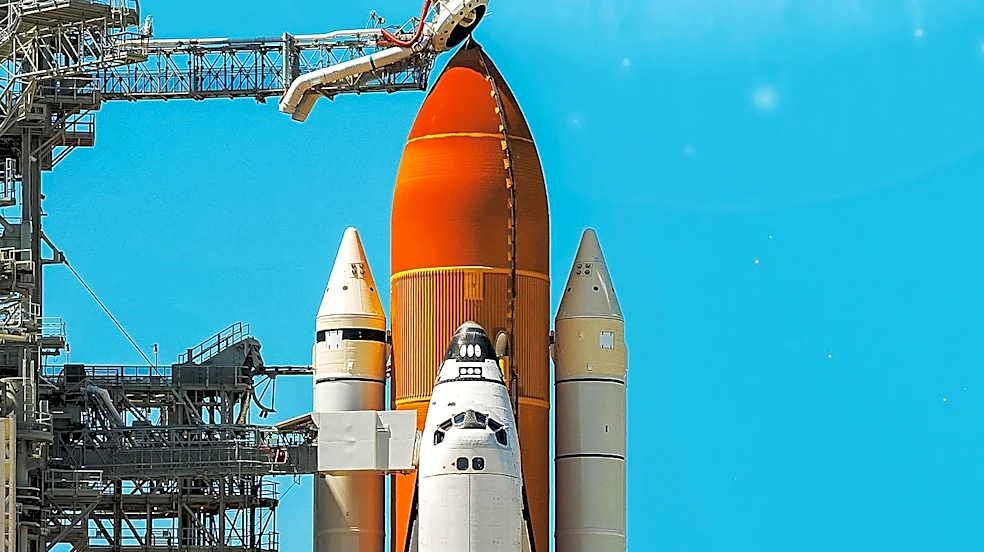








Space Shuttle Atlantis holds a significant place in the history of space exploration, particularly for its role in deploying crucial planetary probes. Its operational life, spanning from its maiden voyage in 1985 to its later missions, saw it achieve several notable milestones, including being the first Space Shuttle to launch an interplanetary probe. Atlantis's missions were diverse, ranging from dedicated Department of Defense operations to scientific
endeavors that expanded humanity's understanding of the solar system. The shuttle's ability to perform complex deployments and its rapid turnaround times underscored its importance to the U.S. space program.
Early Missions and Rapid Turnaround
Atlantis began its service with STS-51-J on October 3, 1985, a mission dedicated to the Department of Defense. This inaugural flight deployed two DSCS-III (Defense Satellite Communications System) satellites into stationary orbit, lasting just over four days. Following this, Atlantis quickly returned to space on STS-61-B on November 26, 1985, marking the second shuttle night launch. This mission deployed three communications satellites: MORELOS-B, AUSSAT-2, and SATCOM KU-2. Notably, Atlantis achieved the shortest turnaround time between missions among the five Space Shuttles flown into space, launching STS-61-B only 50 days after STS-51-J. This rapid succession of flights demonstrated the shuttle's efficiency and readiness for frequent operations before the Challenger disaster temporarily grounded the fleet in 1986.
After the grounding, Atlantis resumed flights, including STS-27 in December 1988, another Department of Defense mission that deployed the Lacrosse 1 satellite. This mission was particularly challenging as Atlantis's Thermal Protection System tiles sustained unusually severe damage, with over 700 damaged tiles noted and one missing. Despite these issues, Atlantis continued its service, proving its resilience and the dedication of the ground crews.
Pioneering Planetary Probe Deployments
Atlantis truly distinguished itself in 1989 with two pivotal missions that deployed interplanetary probes. On May 4, 1989, STS-30 deployed the Magellan probe, which was bound for Venus. This mission made Atlantis the first Space Shuttle to launch an interplanetary probe, a significant achievement that opened new avenues for scientific exploration. The Magellan probe went on to map the surface of Venus using radar, providing unprecedented data about the planet.
Later that year, on October 18, 1989, Atlantis undertook STS-34, deploying the Galileo probe destined for Jupiter. This mission further solidified Atlantis's legacy in planetary science. Galileo became the first spacecraft to orbit an outer Solar System planet and to penetrate the atmosphere of an outer planet. It was designed to conduct extended observations of the Jovian system, perform the first direct sampling of Jupiter's atmosphere, and execute the first asteroid flybys. The successful deployment of both Magellan and Galileo within the same year highlighted Atlantis's critical role in advancing deep space exploration, enabling scientists to gather vital information about two of our solar system's most intriguing planets.
Crew Diversity and Mission Impact
Beyond its scientific and defense contributions, STS-34 also marked a social milestone. It was the first shuttle mission since the Challenger disaster to include two female astronauts on board, Shannon Lucid and Ellen S. Baker. This reflected a growing diversity within the astronaut corps and the broader space program. The mission's success, despite minor in-flight anomalies and launch delays, underscored the robustness of the Space Shuttle system and the professionalism of its crews. Atlantis's continued service through numerous missions, including those that deployed groundbreaking planetary probes, cemented its status as a workhorse of the Space Shuttle fleet and a key player in expanding humanity's reach into the cosmos.