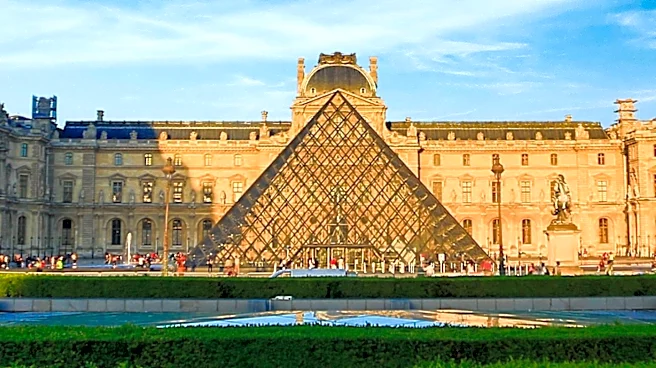









The Louvre Palace, situated on the Right Bank of the Seine in Paris, has a rich and complex history spanning over eight centuries. What began as a defensive castle has undergone numerous transformations, serving intermittently as a royal residence, a hub for various state functions, and ultimately, the home of the world-renowned Louvre Museum. Its evolution reflects the changing political landscape and artistic ambitions of France, making it a monumental
testament to the nation's history.
From Medieval Fortress to Royal Residence
The original Louvre was a nearly square defensive castle, measuring seventy-eight by seventy-two meters, encircled by a thick, crenellated curtain wall and a water-filled moat. It featured ten round defensive towers, including a cylindrical keep known as the Grosse Tour du Louvre, which was thirty meters high with four-meter-thick external walls. This keep was symbolically significant, as all the king's fiefs were traditionally said to depend on it, a formula that persisted until the 18th century, long after the keep's demolition.
In the late 1350s, the construction of a new protective wall, known as the Wall of Charles V, beyond that of Philip II, enclosed the Louvre and diminished its military importance. Shortly after becoming king in 1364, Charles V abandoned the Palais de la Cité and transformed the Louvre into a royal residence. This move was a political statement, with Charles V making the Louvre his "political manifesto in stone," proclaiming the revitalization of France. His architect, Raymond du Temple, oversaw the transformation, which included piercing the curtain wall with windows, adding new wings to the courtyard, and adorning the top with elaborate chimneys, turrets, and pinnacles. This period saw the Louvre become known as the "joli Louvre" or "pretty Louvre."
Renaissance and Grand Designs
In 1528, Francis I ordered the demolition of the old keep, and in 1546, he formally commissioned architect Pierre Lescot and sculptor Jean Goujon to modernize the Louvre into a Renaissance-style palace. Work began in 1545, though Francis I's death in 1547 briefly interrupted it before Henry II ordered design changes in 1549. Lescot tore down the western wing of the old Louvre Castle and rebuilt it as the Lescot Wing, which included the Pavillon du Roi on its southern side. He also designed the Petite Galerie, extending from the southwest corner to the Seine.
During the early 1560s, Lescot began demolishing the southern wing of the old Louvre to duplicate the Lescot Wing. Concurrently, Catherine de' Medici initiated the building of the Tuileries Palace to the west in 1564, on the site of old tile factories. A letter from March 1565 indicates her intention to connect the Tuileries with the older Louvre building. However, work on the Louvre largely ceased in the late 1560s due to the Wars of Religion.
The Grand Louvre Project and Modernization
After the definitive departure of the royal court for Versailles in 1682, the Louvre became occupied by various individuals and organizations, including artists, craftsmen, and academies. It was not until the late 18th century that the idea of transforming the Louvre into a public museum gained significant traction. The French Revolution, beginning in 1789, led to the palace being designated for artistic and scientific functions, with collections of the crown concentrated there. Part of the Louvre first opened to the public as a museum on November 8, 1793.
In September 1981, newly elected French President François Mitterrand proposed the Grand Louvre plan, aiming to move the Finance Ministry out of the Richelieu Wing to allow for significant museum expansion. American architect I. M. Pei was awarded the project and, in late 1983, proposed a modernist glass pyramid for the central courtyard. The Louvre Pyramid and its underground lobby, the Hall Napoléon, opened to the public on March 29, 1989. A second phase, completed in 1993, created underground space below the Place du Carrousel for car parks, exhibition halls, and a shopping mall, featuring the Louvre Inverted Pyramid. The museum's new spaces in the reconstructed Richelieu Wing were inaugurated in November 1993, with a third phase involving the refurbishment of galleries in the Sully and Denon Wings completed by the late 1990s. These modern interventions have solidified the Louvre's status as a premier global museum while honoring its extensive historical layers.
Shifting Functions and Architectural Identity
The Louvre's identity has always been intertwined with French state power, evolving through various modalities within its vast structure. While known as the "Louvre Palace" for its intermittent role as a monarchical residence, this was neither its original nor its sole function. As Percier and Fontaine noted in 1833, it was "viewed as the shrine of [French] monarchy, now much less devoted to the usual residence of the sovereign than to the great state functions, pomp, festivities, solennities and public ceremonies."
Beyond its primary roles, the Louvre has hosted diverse activities. For instance, the national securities exchange (Bourse) was located in Anne of Austria's former summer apartment on the ground floor of the Petite Galerie between May and September 1795. After the Paris City Hall was burned in May 1871, the Municipal Council of Paris and the Prefect of the Seine temporarily relocated to the aile de Flore of the Louvre from 1878 to 1883. These varied uses underscore the palace's adaptability and its enduring significance as a central institution in French public life, continuously evolving to meet the needs of the state and its people.