





Mariner 9, a robotic spacecraft that made history as the first to orbit another planet, was a testament to the engineering capabilities of its era. Launched on May 30, 1971, as part of NASA's Mariner program, its success was underpinned by a robust design and sophisticated subsystems. From its power generation to its propulsion and data handling, every component was meticulously crafted to endure the harsh environment of space and fulfill its ambitious
mission objectives of mapping Mars and studying its atmosphere. The spacecraft's ability to operate effectively for nearly a year in Martian orbit highlights the ingenuity of its construction.
Powering the Mission: Solar Arrays and Battery Storage
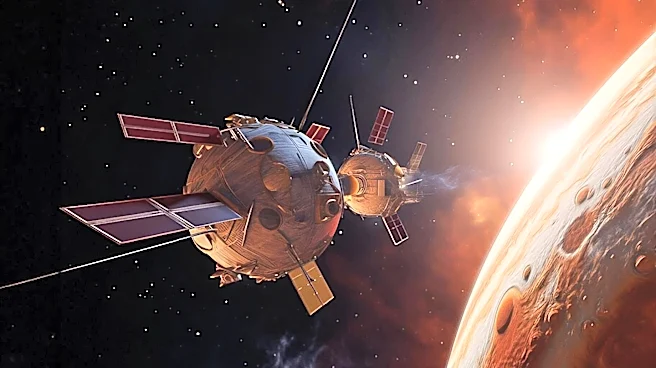
At the heart of Mariner 9's operational longevity was its power system. The spacecraft was equipped with four solar panels, which collectively spanned 7.7 meters. These panels housed a total of 14,742 solar cells, designed to convert sunlight into electrical energy. In the orbit of Mars, these solar panels were capable of producing 500 watts of power, a critical supply for all onboard systems, including scientific instruments, communication equipment, and operational controls. To ensure continuous power availability, especially during periods when solar panels might be shadowed or when peak power demands exceeded immediate generation, the energy was stored in a 20 amp-hour (Ah) nickel-cadmium battery. This combination of solar generation and battery storage provided the necessary electrical backbone for the entire mission.
Propulsion and Orbital Maneuvering
Achieving and maintaining orbit around Mars required a precise and reliable propulsion system. Mariner 9's design included the necessary components for orbital insertion and subsequent adjustments. The spacecraft's ability to enter Mars orbit on November 14, 1971, and then maintain a stable orbit with specific parameters was a direct result of its propulsion capabilities. Its orbital characteristics included a periareion altitude of 1,650 km (1,030 mi) and an apoareion altitude of 16,860 km (10,480 mi), with an inclination of 64.4 degrees. The orbital period was approximately 11.9 hours, or 719.47 minutes. These precise orbital parameters were crucial for fulfilling its mapping and observation goals, allowing it to cover 85% of the Martian surface with its imaging systems.
Data Handling and Communication
Beyond power and propulsion, Mariner 9 incorporated advanced systems for data acquisition and transmission. The spacecraft successfully returned 7,329 images, a testament to its imaging capabilities and its ability to store and transmit this vast amount of data back to Earth. The mission's success in providing high-resolution images and atmospheric data relied on its communication systems and onboard data recorders. These systems allowed Mariner 9 to capture detailed views of Mars, including its surface features and atmospheric phenomena, and relay them across millions of miles. The ability to store images digitally, rather than using film, was a significant technological advancement that allowed for greater flexibility, especially when waiting for the Martian dust storms to clear before beginning its primary imaging sequence.