

Hair coloring, a practice as old as civilization, has undergone a remarkable transformation, evolving from rudimentary plant-based applications to a sophisticated multibillion-dollar industry dominated by synthetic dyes. The primary motivations for changing hair color remain largely cosmetic: to conceal gray or white hair, to achieve a desired aesthetic, or to restore hair's original color after environmental or chemical alteration. This journey from ancient
techniques to advanced chemical formulations highlights significant milestones, including the pioneering work of Eugène Schueller and the introduction of home coloring products, which have made hair dyeing accessible to millions worldwide.
Historical Roots and the Rise of Synthetics
Historically, hair coloring relied heavily on natural sources. However, the landscape of hair dyeing began to change dramatically in the early 20th century with the advent of synthetic chemistry. Eugène Schueller, the founder of L'Oréal, is credited with creating the first synthetic hair dye in 1907, marking a pivotal moment in the industry. This innovation paved the way for more consistent, durable, and varied color options. The accessibility of hair coloring further expanded in 1947 when the German cosmetics firm Schwarzkopf launched "Poly Color," the first home color product, democratizing a process once confined to salons or complex personal preparations. Today, the industry utilizes both plant-derived and synthetic dyes, but the latter accounts for the vast majority of products due to their performance and versatility.
Application Techniques: Precision and Coverage
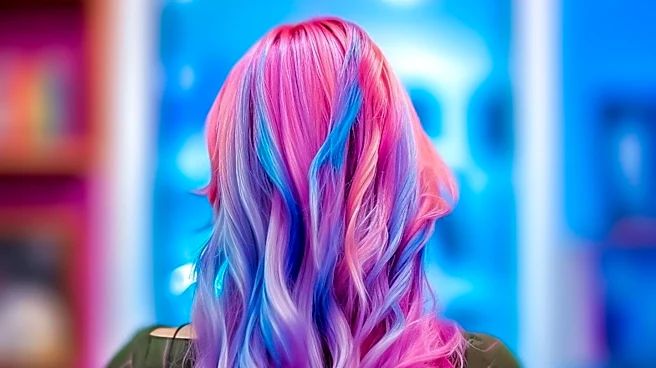
Modern hair coloring employs a variety of application techniques, adaptable to any type of color and desired effect. These techniques can be broadly categorized into off-scalp and on-scalp methods. Off-scalp techniques, which have gained popularity for creating nuanced effects, include highlighting, lowlighting, and splashlighting. Highlighting involves treating sections of hair with lighteners, while lowlighting uses darker hair colors. Splashlighting creates a horizontal band of bleached hair. Newer methods like ombré, shatush, balayage, and airtouch create a gradient effect, typically darker at the crown and progressively lighter towards the ends. These are often applied using foils to isolate sections, or through balayage, where color is painted directly onto the hair for a more natural look. Baby lights, very thin highlights, offer subtle results, and tip dyeing involves dipping hair ends directly into dye.
On-scalp applications, conversely, aim for more solid and uniform coverage. All-over color is used when a person desires a single, consistent color throughout their hair. Root touch-ups are a common on-scalp technique, where color is applied only to the new growth near the scalp, typically every 4 to 6 weeks, especially for those covering gray hair. Block coloring involves applying two or more colors to create dimension and contrast. The choice of technique depends on the desired outcome, ranging from subtle enhancements to dramatic transformations, all facilitated by the diverse range of available hair color products.
The Spectrum of Synthetic Hair Dyes
Synthetic hair dyes are classified into four main categories: permanent, demi-permanent, semi-permanent, and temporary, each offering different levels of longevity and chemical interaction with the hair. Permanent synthetic dyes typically contain ammonia and require a developer (oxidizing agent) to open the hair's cuticle layer, allowing colorants to penetrate the cortex and permanently alter the hair's natural pigment. The concentration of the developer determines the degree of "lift" or lightening. This process results in a lasting color change, though timing can vary, usually between 30 to 45 minutes for maximum effect.
Demi-permanent synthetic dyes use an alkaline agent other than ammonia, such as ethanolamine or sodium carbonate, and a lower concentration of hydrogen peroxide. These dyes provide minimal lightening and cannot color hair to a lighter shade than its original color, making them less damaging. They are effective at covering gray hair, though less so than permanent dyes, and wash out over time (typically 20 to 28 shampoos), offering a more natural look with less noticeable root regrowth. Semi-permanent synthetic dyes are even gentler, containing no developer or ammonia. They have lower molecular weight compounds that wedge under the cuticle layer, surviving 4–8 shampoos. They cannot lighten hair and result in subtle variations in shade depending on the hair's original color and porosity. Temporary hair color, available in rinses, sprays, and foams, consists of pigments that remain adsorbed to the hair shaft's surface and are easily removed with a single shampoo, often used for vibrant, short-term effects.