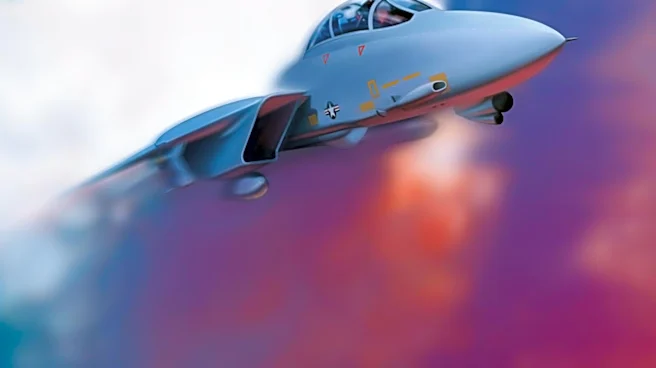







The Grumman F-14 Tomcat stands as a significant icon in the history of naval aviation, serving as the United States Navy's primary maritime air superiority fighter, fleet defense interceptor, and tactical reconnaissance platform for over three decades. From its introduction in 1974 until its retirement in 2006, the F-14 was a supersonic, twin-engine, two-seat aircraft distinguished by its variable-sweep wings. Its development was a response to the Navy's need
for a successor to the F-4 Phantom II, aiming to counter advanced Soviet threats and provide robust defense for aircraft carrier battle groups.
Origins and Design Philosophy
The F-14's journey began in the 1960s when the U.S. Navy sought a long-range interceptor to defend its carrier groups against sophisticated anti-ship missiles launched by Soviet bombers and submarines. This requirement led to the Fleet-Air-Defense (FAD) fighter concept, which demanded a more powerful radar and longer-range missiles than those found on the F-4 Phantom II. Initially, the Navy was compelled to participate in the U.S. Air Force's TFX program, which resulted in the F-111B, a variant of the F-111 Aardvark. However, the F-111B proved too heavy and large for carrier operations, leading to its cancellation in 1968.
Following the F-111B's failure, the Navy launched a new competition, which Grumman won with its Model 303. Grumman's proposal leveraged its experience with variable-sweep wing technology, previously explored in the XF10F Jaguar prototype, and incorporated the advanced Hughes AWG-9 radar. The F-14 was designed as a two-man aircraft, featuring tandem seating for a pilot and a Radar Intercept Officer (RIO), each equipped with Martin-Baker GRU-7A ejection seats. This configuration, inspired by the F-4 Phantom II, offered operational flexibility. The aircraft's variable-sweep wings were a defining characteristic, allowing them to pivot between 20 and 68 degrees in flight, optimized by a Central Air Data Computer (CADC) for the best lift-to-drag ratio across different speeds. On the ground, the wings could sweep back to 75 degrees to save space on crowded aircraft carriers.
Operational Service and Evolution
The F-14 made its first flight on December 21, 1970, just 22 months after Grumman secured the contract. Despite an early prototype crash, the test program progressed, and the F-14 achieved Initial Operational Capability in 1973, entering service with the U.S. Navy in September 1974. Its initial role was primarily as an interceptor, armed with up to six long-range AIM-54 Phoenix missiles, which could engage targets up to 160 kilometers away and be fired simultaneously at multiple threats. This beyond-visual-range capability was unprecedented for a carrier-based aircraft of its era.
Over its service life, the F-14 underwent significant upgrades. The original Pratt & Whitney TF30 engines, which were often criticized for their reliability and performance, were eventually replaced in later models. The F-14A+ (later designated F-14B) and F-14D variants received the more powerful General Electric F110-GE-400 engines, which improved thrust-to-weight ratio and overall performance. The F-14D also featured enhanced avionics, a glass cockpit, and Link 16 data link capabilities. Furthermore, the F-14's mission expanded beyond air-to-air combat. With the retirement of the A-6 Intruder, the F-14 gained air-to-ground capabilities, becoming known as the "Bombcat." It was equipped with the Low Altitude Navigation and Targeting Infrared for Night (LANTIRN) pod, allowing it to deploy laser-guided bombs and, later, GPS-guided Joint Direct Attack Munitions (JDAMs). This transformation into a multi-role platform ensured its continued relevance until its retirement from U.S. Navy service in 2006, when it was replaced by the F/A-18E/F Super Hornet.