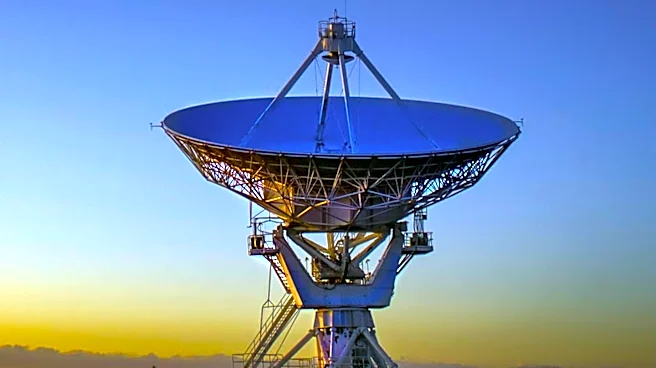



The Karl G. Jansky Very Large Array (VLA), officially renamed in 2012, stands as a prominent radio astronomy observatory nestled in the Plains of San Agustin in central New Mexico. Located approximately 50 miles west of Socorro, between the towns of Magdalena and Datil, this facility is a cornerstone for exploring the universe through radio waves. Operated by the National Radio Astronomy Observatory, the VLA is not a single telescope but a sophisticated
interferometer comprising 28 individual radio telescopes, each with a substantial dish diameter of 25 meters, arranged in a distinctive Y-shaped configuration.
The Unique Y-Shaped Configuration and Mobility
The VLA's design is centered around its Y-shaped array, which is crucial for its function as an interferometer. This configuration allows the array to act as a single, much larger antenna, providing exceptional angular resolution. Each of the 27 operational antennas (with one spare rotating through maintenance) weighs 209 metric tons (230 short tons) and is mounted on double parallel railroad tracks. These tracks extend along three arms, each 21 kilometers (13 miles) long, radiating out from a central point. The ability to relocate these massive antennas along the tracks is a key feature, enabling astronomers to adjust the array's radius and density.
This mobility allows for a dynamic balance between angular resolution and surface brightness sensitivity. A specially designed lifting locomotive, known as "Hein's Trein," is used to move the antennas to various prepared positions. This flexibility in configuration means the VLA can synthesize up to 351 independent baselines, effectively changing its diameter to suit different observational needs. The tracks even intersect with U.S. Route 60 at a level crossing, highlighting the scale of this engineering marvel.
Diverse Astronomical Investigations
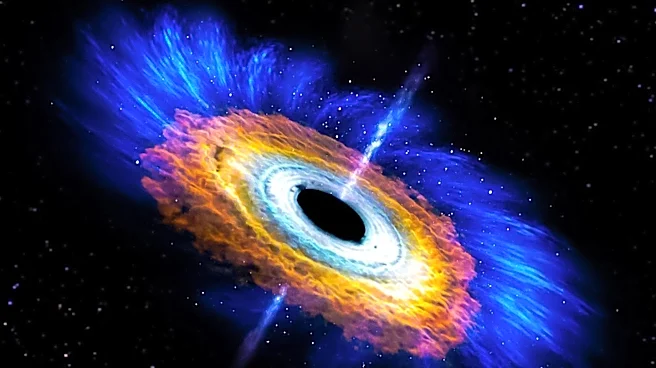
The VLA is a multi-purpose instrument, meticulously designed to facilitate investigations into a wide array of astronomical objects and phenomena. Its capabilities extend to studying distant and energetic objects like radio galaxies and quasars, as well as the remnants of stellar explosions known as supernova remnants. It also plays a vital role in observing pulsars, which are rapidly rotating neutron stars, and gamma-ray bursts, some of the most powerful explosions in the universe.
Beyond these exotic phenomena, the VLA is instrumental in understanding more familiar celestial bodies. It is used to study radio-emitting stars, our own Sun and other planets within our solar system, and astrophysical masers. A significant focus of its research is the hydrogen gas that forms a large portion of the Milky Way galaxy, as well as external galaxies, providing insights into galactic structure and evolution. In a notable application in 1989, the VLA was even used to receive radio communications from the Voyager 2 spacecraft during its flyby of Neptune, demonstrating its versatility beyond purely astronomical observations.
Public Access and Educational Outreach
Despite its remote location, the VLA is accessible to the public, offering a unique opportunity for visitors to learn about radio astronomy. The site, situated between Magdalena and Datil, about 50 miles west of Socorro, New Mexico, welcomes visitors with paid admission. A visitor center provides a small museum, a theater, and a gift shop, enhancing the educational experience. For those who wish to explore the facility more closely, a self-guided walking tour is available, allowing individuals to observe the massive antennas and learn about their operation.
One of the notable features on the walking tour is the Bracewell Radio Sundial, named after Ronald N. Bracewell. This sundial marks the positions of the central sphere's shadow at different times of day and year, and even indicates the "shadows" of radio sources like Cygnus A and Cassiopeia A. The VLA also offers a virtual tour called the VLA Explorer for those unable to travel to the site. Visitors are advised that food options are limited in the sparsely populated surroundings and to be prepared for variable high desert weather, which can remain cold into April.