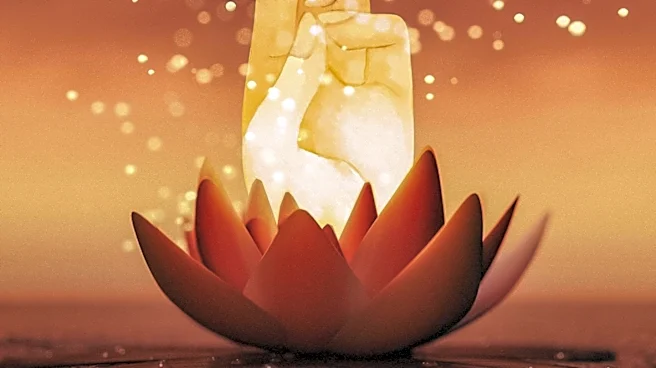






Chinmudra is a significant symbolic hand gesture found in various Indian religions, including Hinduism, Yoga, and Buddhism. This mudra, or ritual gesture, is primarily formed with the hands and fingers, and it carries deep symbolic meaning, often representing consciousness, meditation, and the transmission of teachings. While many mudras exist, Chinmudra is particularly recognized for its specific formation and the spiritual concepts it embodies across
these diverse traditions.
The practice of mudras, in general, involves symbolic or ritual gestures or poses. Although some mudras engage the entire body, the majority are performed using the hands and fingers. These gestures are not merely physical acts; they are integral to the iconography and spiritual practices of Indian religions, serving as visual shorthand for complex philosophical ideas and moments of spiritual significance.
The Formation and Meaning of Chinmudra
Chinmudra is formed by joining the tips of the thumb and the index finger, while keeping the other fingers extended straight. This specific configuration is central to its symbolic interpretation. In the context of Indian-origin religions, this mudra is often associated with spiritual enlightenment and the unity of individual consciousness with universal consciousness. The circle formed by the thumb and index finger symbolizes the ultimate reality or the divine, while the three extended fingers represent the three gunas (qualities of nature) or the three states of consciousness.This gesture is also known as the "mudra of discussion" or "mudra of explanation" in Buddhism, where it is referred to as Vitarka mudra or Vyākhyāna mudra. In this context, it signifies the transmission and discussion of Buddhist teachings. The similarity in formation to other mudras like Abhaya and Varada mudras is noted, but the specific touch of the thumb and index finger distinguishes it, emphasizing its role in conveying wisdom and understanding.
Chinmudra in Buddhist Traditions
Within Mahayana Buddhism, the Vitarka mudra, also called Chinmudra, has numerous variations. It is a ritual gesture frequently depicted with Tārās and bodhisattvas in Tibetan Buddhism, with specific variations depending on the deities, particularly in Yab-Yum representations. This highlights its adaptability and importance within different schools and iconographic representations of Buddhist deities.The gesture's association with discussion and explanation underscores its role in the dissemination of Buddhist doctrine. It visually communicates the act of teaching and the intellectual engagement with spiritual truths. The presence of this mudra in various Buddhist art forms, from ancient Gandhara to later periods in China, demonstrates its enduring significance as a symbol of enlightened discourse and the sharing of wisdom.
Broader Context of Mudras
Chinmudra exists within a rich tapestry of mudras used in Hinduism, Jainism, and Buddhism. These symbolic gestures are described in ancient scriptures, such as the Nāṭyaśāstra, which details numerous one-hand and two-hand mudras. Mudra positions are not only static elements in meditation and iconography but are also dynamically employed in practices like the Nāṭya tradition of Hinduism.Beyond their spiritual and iconographic roles, mudras also hold meaning in various forms of Indian dance and yoga. While the range of mudras can differ across fields and religions, there is often some overlap. Many Buddhist mudras, including those related to Chinmudra, have spread beyond South Asia, evolving into different local forms in other regions, showcasing their universal appeal and adaptability.