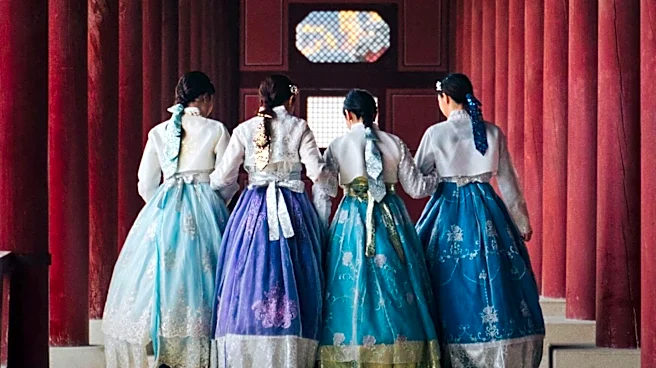






The traditional Korean attire, hanbok, has undergone a fascinating evolution shaped by internal cultural shifts and significant external influences over centuries. From its ancient nomadic roots to its distinct forms in various dynastic periods, the hanbok reflects a dynamic history of adaptation and cultural exchange. While its fundamental components have remained consistent, the length, width, and shape of its garments have continuously transformed,
offering a visual timeline of Korean history and its interactions with neighboring cultures.
Ancient Origins and Early Forms
The earliest forms of hanbok can be traced back to the nomadic clothing of the Eurasian Steppes, particularly Iranian Scythian styles, which spread across Siberia to Northeast Asia. This nomadic heritage is evident in the practical design of early hanbok, which facilitated horse-riding and ease of movement, featuring trousers and jackets for men. Visual evidence of ancient hanbok appears in Goguryeo tomb murals from the 4th to 6th centuries CE. These murals depict both men and women wearing trousers, long jackets, and sash-like belts. Women often layered skirts over their trousers, establishing a basic structure that has largely persisted.During this early period, the *jeogori*, or jacket, was hip-length with narrow sleeves, a straight, crossed collar, and was tied at the waist with a belt. Collars and cuffs were frequently adorned with contrasting colored trim. The way the *jeogori* closed also evolved; initially, it might have closed at the center front or to the left, but by the sixth century CE, closing to the right became the standard practice. Early Goguryeo *jeogori* were sometimes Persian-styled Kaftan tunics, belted at the waist, and *po* (overcoats) were full body-length Kaftan robes, also belted. Pants were roomy, similar to those found at Xiongnu burial sites, with some aristocrats wearing tighter ankle bindings as a potential status symbol.
Silla and Balhae: Tang Dynasty Influences
The Unified Silla period (668-935 CE) marked a significant era of cultural exchange, often referred to as a golden age for Korea. During this time, various silks, linens, and fashions were imported from Tang China and Persia. King Munmu of Silla decreed in 664 CE that the queen's costume should resemble Tang dynasty attire, leading to the adoption of Tang styles in women's clothing, such as shoulder straps on skirts and wearing skirts over the *jeogori*. The Tang court dress regulations were influential in the Silla court, leading to extravagant attire. However, this extravagance eventually led King Heundeog to enforce a prohibition on Tang clothing in 834 CE, suggesting a push to maintain distinct Korean styles.Balhae (698–926 CE), a kingdom founded by Goguryeo refugees and Mohe people, also experienced diverse influences. While early Balhae officials continued Three Kingdoms period traditions, later periods, particularly after Mun of Balhae, saw the incorporation of Tang dynasty elements like the *putou* (headwear) and round-collared gowns for official attire. Balhae women's clothing adopted elements from the Tang dynasty, such as upper garments with long sleeves partially covered by long skirts, but also uniquely featured the *ungyeon* (a silk shawl) in the late Balhae period, distinguishing it from Tang shawls. Balhae's clothing culture was thus heterogeneous, blending Goguryeo, indigenous Mohe, and Tang influences.
Goryeo Dynasty: Mongol Impact and Bilateral Exchange
The Goryeo dynasty (918–1392) witnessed profound changes in hanbok, particularly under Mongol rule. After a peace treaty with the Mongol Empire in the 13th century, Mongolian princesses marrying into the Korean royal house introduced Mongolian fashion, which became prevalent in both formal and private life. King Chungryeol, as an imperial son-in-law of the Mongol Empire, even directed the aristocracy to adopt Mongol clothing. This influence, known as *Mongolpung*, led to a shortened *chima* (skirt), a *jeogori* hiked above the waist and tied with a long, wide ribbon (*goreum*) instead of a sash, and slightly curved sleeves.However, the cultural exchange was bilateral. Goryeo fashion, known as *Goryeoyang* ("the Goryeo style"), also influenced the Mongol court of the Yuan dynasty, especially in the attire of aristocrats, queens, and concubines in Khanbaliq. This influence was particularly strong in the late Yuan dynasty, associated with the rise of Goryeo-born Empress Gi. The widespread presence of Goryeo women in the Yuan palace led to a craze where