
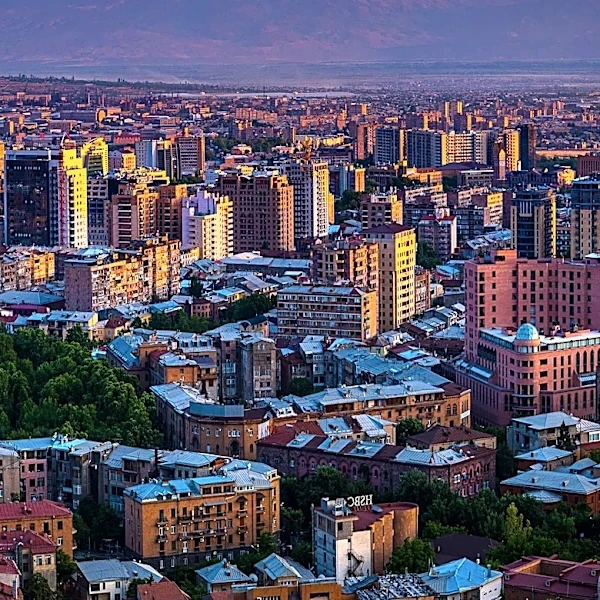




Yerevan, the capital of Armenia, has undergone a profound urban evolution, transforming from an ancient fortified settlement into a bustling modern metropolis. Its history, stretching back to the Erebuni Fortress founded in 782 BC, is marked by cycles of destruction and ambitious reconstruction. The city's physical layout and architectural character reflect the influences of various empires and the visionary plans of its architects, particularly during
the Soviet era. This journey showcases a continuous effort to adapt, rebuild, and redefine its urban identity, culminating in the vibrant city seen today.
Early Settlements and Medieval Urban Fabric
The earliest evidence of human habitation in the Yerevan area dates back to the 4th millennium BC, with significant settlements like Shengavit showing organized community life. The foundation of the Erebuni Fortress in 782 BC by King Argishti I marked a pivotal moment, establishing a fortified center that would eventually lend its name to the modern city. This fortress served as an economic, political, and military hub for the Urartian kingdom, indicating early strategic urban planning.During the medieval period, Yerevan developed as a feudal city, becoming the capital of Kotayk province. While specific details of its medieval urban plan are scarce due to repeated destruction, records indicate its importance as a regional center. French traveler Jean Chardin, visiting in the late 17th century, noted the Armenian belief in Yerevan as the world's oldest settlement, linking its foundation to Noah. This deep historical consciousness likely influenced its continuous re-establishment despite numerous devastations, such as the earthquake in the 17th century that nearly destroyed the town. Few buildings from the old Erivan survived, highlighting the constant need for rebuilding.
Imperial Influences and the Qajar Period Cityscape
Under Persian domination, particularly during the Qajar period, Yerevan achieved considerable prosperity and developed a distinct urban character. The city occupied an area of 1.6 square kilometers, with its outskirts and parks extending over approximately 28.9 square kilometers. Its urban and architectural model conformed to general schemes prevalent in Near Eastern cities. Yerevan was divided into four quarters or mahallahs: Shari, Tappa-Bashi, and Demir-Bulag. At this time, it boasted 1,700 houses, 850 stores, 8-9 mosques, seven churches, 10 bathhouses, seven caravanserai, five squares, and two markets and schools.Notable surviving structures from this period included the belfry of a 12th-century medieval Armenian cathedral, four small 18th-century churches (St. Zoravor, St. Hovhannes, St. Sarkis, and St. Peter and Paul), and bridges over the Getar (1664) and Hrazdan (1679) rivers. The Shir Mosque (1687) and the Blue Mosque (1776) were significant Islamic architectural contributions, with the Blue Mosque being the largest in the city. The Khan's palace was also located near one of the mosques. This period illustrates a multi-cultural urban environment, shaped by both Armenian and Persian architectural traditions.
Soviet-Era Transformation and Modern Planning
At the time of Armenia's independence in 1918, Yerevan was a town of only 20,000 people. However, with its designation as the capital, large-scale construction began, taking a holistic approach under the new city plan laid out by architect Alexander Tamanyan. Tamanyan's vision aimed to transform Yerevan into a metropolis of 200,000 people, featuring concentric circles, parks, and taller structures, often involving the demolition of existing older buildings. This plan laid the groundwork for the city's modern layout.During the Soviet years, Yerevan underwent massive reconstruction, following Tamanyan's plan to create a "perfect city"—a Neo-Classical town with wide avenues, reminiscent of European capitals like Paris, Vienna, and Saint Petersburg. This resulted in a city that is easily accessible by foot, boasting a dense assortment of parks, galleries, museums, and other public institutions. Central Yerevan became known for its early Soviet architecture, a grid within a circular road, and large-scale Modern and Post-Modern marvels, often a result of Soviet-Armenian hybridization. The city earned the nickname "Pink City" due to the color of the tufa stone used for building, as well as the flamboyant spirit of its young population. This period also saw the development of the Yerevan Metro, a rapid transit system that opened in 1981, further enhancing the city's infrastructure and connectivity.