



On September 1, 1894, the pine forests of Minnesota became the stage for one of the deadliest conflagrations in U.S. history: the Great Hinckley Fire. This devastating event, which claimed over 400 lives and scorched at least 200,000 acres, was not merely a random act of nature. It was a disaster fueled by a combination of severe environmental conditions and prevailing logging practices of the era, which together created a tinderbox ripe for an inferno.
The fire's rapid escalation into a firestorm highlights the precarious balance between human activity and the natural world, especially in a landscape made vulnerable by drought.
The Tinderbox: Drought and Logging Debris
The summer of 1894 had been exceptionally dry, marked by a two-month drought and very high temperatures in Pine County, Minnesota. This prolonged aridity turned the vast pine forests into highly flammable terrain. Adding to this natural vulnerability were the common logging practices of the time. Lumber harvesting involved stripping trees of their branches in place, leaving behind a significant amount of highly combustible debris scattered across the forest floor. This "slash" acted as a perfect fuel source, ensuring that any small spark could quickly grow into a larger blaze.
Small fires were a regular occurrence in late-summer rural Minnesota, often ignited by steam locomotives along railroad tracks. These bog and grass fires, usually manageable, found an unprecedented amount of fuel in the drought-stricken, debris-laden forests. Two such fires, specifically, ignited along the railroad tracks southwest and south of Hinckley, in Quamba and Brown's Hill. These seemingly ordinary blazes were the precursors to the catastrophe, their spread exacerbated by the abundant flammable material left from logging.
The Firestorm Unleashed: September 1, 1894
The fateful day of September 1, 1894, began with an ominous cloud of smoke hanging over Hinckley, though many initially dismissed it as common. However, by noon, a strong wind began to blow, and the situation rapidly deteriorated. A gust of sparks landed in the yard of the Brennan Lumber Company, igniting small fires that, despite being quickly extinguished, signaled a growing threat. Concerned townsfolk began to leave on the noon train, a decision that would prove prescient.
By 1:00 PM, Chief John Craig of the Hinckley volunteer fire department called his men to prepare for what they still suspected was a brush fire. Just half an hour later, the wind from the south intensified, and the fire began its terrifying advance toward the town with frightening rapidity. The scattered blazes, fueled by the strong winds and dry conditions, united into a single, massive firestorm. A temperature inversion also played a critical role, trapping gases from the fires and contributing to the intensity of the conflagration. This inversion, combined with the heat, smoke, and gases, created a vortex or tornado of flames when the fire eventually broke through the cool air layer above, drawing in more air and growing exponentially.
Rapid Destruction and Escalating Casualties
The firestorm's destructive power was immediate and overwhelming. At 2:00 PM, the town of Pokegama, located nine miles south of Hinckley, was razed, resulting in 23 casualties. Many residents there sought refuge in a nearby mill pond, only for a burning railroad trestle to collapse into it, cutting off a vital escape route. In Hinckley, volunteer firefighters made a stand on the south edge of town, battling spot fires thrown ahead of the main inferno. However, by 2:30 PM, the small hamlet of Mission Creek, just south of Hinckley, was also consumed by the flaming front, though its residents managed to escape by taking cover in a potato field.
As the afternoon progressed, the fire's intensity became unbearable. By 3:45 PM, a searing wind carried a curtain of dense black smoke, cinders, and firebrands through Hinckley's streets. The radiating heat was so extreme that many townspeople's clothes caught fire even before the main blaze reached them. At 4:00 PM, the temperature soared to at least 2,000°F, causing barrels of nails to melt into a single mass. The town of Hinckley "virtually exploded" as its wood-frame buildings succumbed to the heat. Burning balls of gas drifted overhead, exploding in the air, and the roar of the firestorm drowned out the screams of the townspeople. The sun was completely obscured by dense smoke, with only the brief, lightning-like flashes of burning buildings illuminating the darkness. Frame buildings detonated like fireworks, signaling the complete and utter destruction of the town in a matter of minutes.
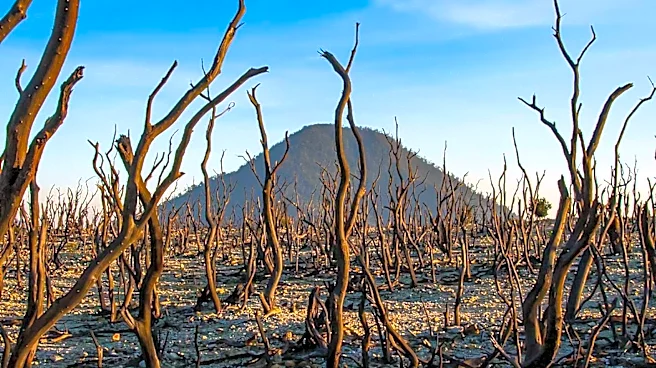
The firestorm, though lasting only four hours, utterly destroyed six towns and left over 400 square miles black and smoldering. The scale of the disaster was immense, a stark reminder of how environmental factors, when combined with human practices, can lead to catastrophic outcomes. The official death count was 418, but the actual number of fatalities was likely higher, with many Native Americans and backcountry dwellers uncounted in the official records. Bodies continued to be found years later, some buried where they lay, underscoring the profound and lasting impact of the Great Hinckley Fire.