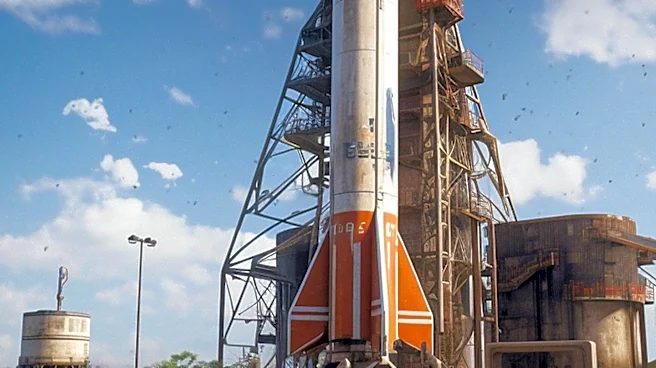







The LGM-25C Titan II intercontinental ballistic missile (ICBM) stood as a formidable component of America's strategic deterrent force during the Cold War. Developed as the successor to the Titan I, the Titan II represented a significant leap in missile technology, capable of carrying a larger warhead over a greater range with improved accuracy. Its design allowed for rapid launch directly from its silo, a critical advantage in the tense geopolitical
climate of the era. However, this advanced capability came with inherent risks, primarily due to its use of highly toxic and corrosive hypergolic propellants.
Design and Operational Advantages of the Titan II
The Titan II was a two-stage, rocket-engine-powered vehicle, measuring 10 feet in diameter for both stages. Its design incorporated fuel and oxidizer tanks in tandem, with the tank walls forming the missile's skin. External conduits provided passage for wiring and tubing, while access doors allowed for inspection and maintenance. A key innovation was its guidance system, initially built by AC Spark Plug using an inertial measurement unit (IMU) and an IBM ASC-15 missile guidance computer (MGC). Later, this was replaced by the more modern Delco Electronics Universal Space Guidance System (USGS) to reduce maintenance costs.
Unlike its predecessor, the Titan I, which used liquid oxygen and RP-1 propellants requiring fueling immediately before launch, the Titan II utilized storable hypergolic propellants. This allowed the missile to be launched within 60 seconds directly from its silo, a significant operational advantage. The first Titan II guidance system was built by AC Spark Plug, using an inertial measurement unit from original designs by the Charles Stark Draper Laboratory at MIT. The missile guidance computer (MGC) was the IBM ASC-15. When spares became difficult to obtain, it was replaced by the Delco Electronics Universal Space Guidance System (USGS), which used a Carousel IV IMU and a Magic 352 computer. This upgrade, completed in 1981, aimed to reduce maintenance costs by $72 million per year.
The Double-Edged Sword of Hypergolic Propellants
The choice of hypergolic propellants for the Titan II was a strategic one, offering the benefit of instant ignition upon contact, which facilitated rapid launch. The fuel was Aerozine 50, a 50/50 mixture of hydrazine and unsymmetrical dimethylhydrazine (UDMH), and the oxidizer was dinitrogen tetroxide (NTO). This combination eliminated the need for cryogenic storage, a major drawback of liquid oxygen, which is dangerous in enclosed spaces and cannot be stored for long periods in booster oxidizer tanks. The Titan I, for instance, had to be raised from its silo and fueled before launch, a time-consuming process.
However, the hypergolic nature of these propellants presented significant hazards. They were highly toxic and corrosive liquids, making them extremely dangerous to handle. A leak, as tragically demonstrated in the 1980 Damascus incident, could lead to catastrophic explosions. The 1980 Damascus Titan missile explosion, where a dropped wrench punctured a fuel tank, resulted in a leak that culminated in a powerful explosion, killing one airman and injuring 21 others. This incident starkly illustrated the inherent risks associated with maintaining and operating missiles fueled by such volatile substances, even as the warhead's safety features prevented a nuclear detonation.