





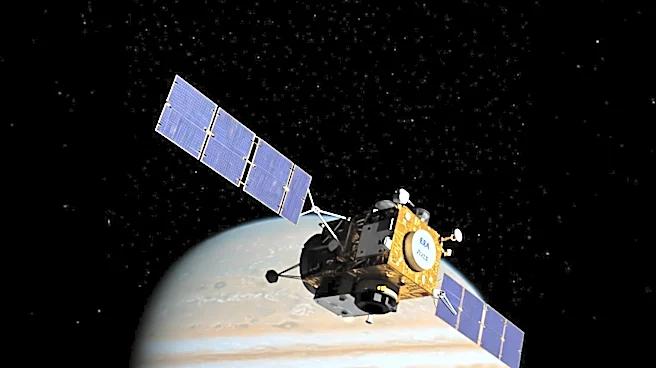
Since its arrival at Jupiter in 2016, the Juno spacecraft has been instrumental in uncovering the planet's secrets. Through its advanced instruments, Juno has provided groundbreaking insights into Jupiter's atmosphere, magnetic field, and core composition. This article explores the scientific discoveries made by Juno and their implications for our understanding of the gas giant.
Insights into Jupiter's Atmosphere
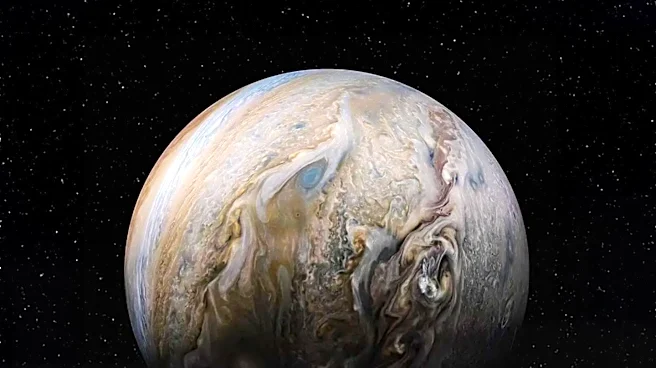
Juno has revolutionized our understanding of Jupiter's atmosphere. The
spacecraft's Microwave Radiometer has revealed that the planet's iconic red and white bands extend hundreds of kilometers into the atmosphere. This discovery challenges previous assumptions about the uniformity of Jupiter's interior, suggesting a complex and uneven composition.
Moreover, Juno has provided detailed observations of Jupiter's storms, including the Great Red Spot. These storms are far taller than expected, with some extending over 200 miles below the cloud tops. Juno's data has allowed scientists to measure velocity changes with remarkable precision, offering new insights into the dynamics of these massive atmospheric phenomena.
Magnetic Field and Core Composition
Juno's Magnetometer has mapped Jupiter's magnetic field, revealing its uneven and chaotic nature. This has led to the theory that Jupiter may not have a solid core, as previously thought, but rather a "fuzzy" core composed of rock and metallic hydrogen. This peculiar core structure may be the result of a collision during Jupiter's formation.
The spacecraft has also observed Jupiter's aurorae and polar magnetosphere, providing a three-dimensional view of these phenomena. Juno's findings have challenged existing theories about the planet's magnetic field, offering new perspectives on its formation and evolution.
Ongoing Discoveries
Juno's mission continues to yield new discoveries, with the spacecraft remaining operational as of 2026. In 2021, Juno's analysis of interplanetary dust impacts suggested that the zodiacal light originates from Mars, rather than comets or asteroids. This finding has implications for our understanding of the solar system's dust distribution.
Juno's observations of solar flares impacting Jupiter have provided insights into the planet's magnetosphere and its interactions with solar activity. These discoveries highlight the dynamic nature of Jupiter and its environment, offering a glimpse into the complex processes at play in the outer solar system.
Through its scientific discoveries, Juno has deepened our understanding of Jupiter, challenging existing theories and paving the way for future exploration. The spacecraft's ongoing mission promises to continue unveiling the mysteries of the gas giant, contributing to our knowledge of the solar system and beyond.