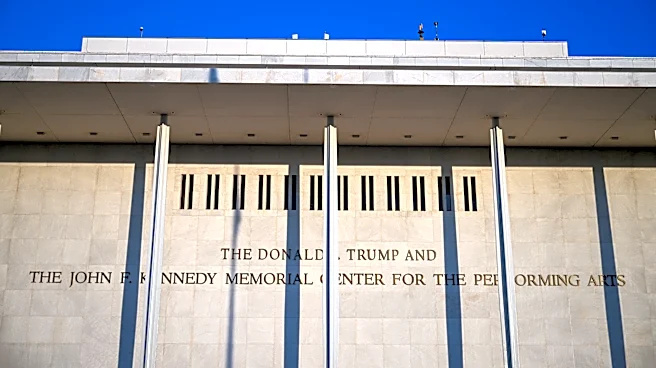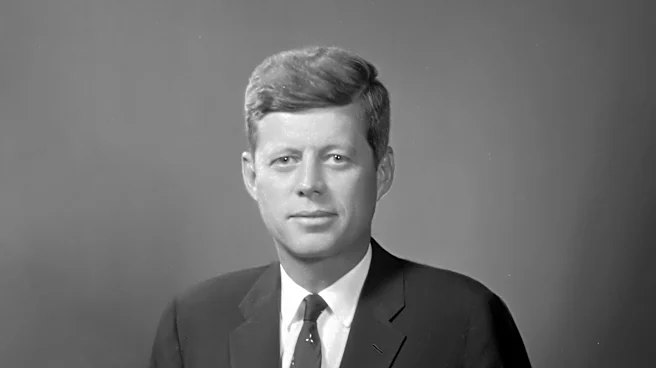

At the heart of the John F. Kennedy Center for the Performing Arts in Washington, D.C., stands a monumental bronze bust of the 35th President of the United States, John F. Kennedy. Sculpted by Robert Berks in 1971, this eight-foot-high artwork is not merely a decorative piece but an iconic symbol and the centerpiece of the Kennedy Center's Grand Foyer. Its creation was a direct response to the national desire to memorialize President Kennedy after
his assassination, transforming the planned cultural center into a "living memorial" to his legacy. The bust's imposing size and strategic placement contribute significantly to the atmosphere and identity of the institution.
Conception and Artistic Vision
The idea for a memorial to President Kennedy quickly followed his assassination in November 1963. Just two months later, Congress passed and President Lyndon B. Johnson signed Public Law 88-260, officially designating the John F. Kennedy Center for the Performing Arts as a "living memorial" to Kennedy. Robert Berks, a renowned American sculptor of the era, was deeply moved by Kennedy's death and felt compelled to create a memorial. He initially fashioned a half-life-size bust in Kennedy's honor. The Kennedy family was impressed by this initial sculpture, which led to a commission for a larger work specifically for the performing arts center. This significant undertaking was supported in part by charitable contributions from Mr. and Mrs. Thomas J. Watson, Jr.
Berks meticulously considered the scale of his creation, recognizing the immense size of the Grand Foyer, which was designed to be 630 feet long. To determine the optimal size for the bust, he conducted an unusual experiment. He painted six-foot, eight-foot, and ten-foot-high plywood panels, each featuring a rough image of Kennedy's head. He then placed these panels in an abandoned potato field near his Long Island home, marking out a distance of 630 feet to simulate the foyer's length. From this practical test, Berks concluded that an eight-foot bust would be the most appropriate size to command the space effectively. He famously remarked that the bust's size and placement seemed to "reduce the scale of the Grand Foyer," creating an intimate feeling where "you and the president are totally alone. He fills the place. He is the life force of the center."
Physical Presence and Artistic Style
The finished bust, standing eight feet high and crafted from bronze, rests on an approximately 10-foot-high travertine marble pedestal. This combined height of roughly 18 feet ensures its commanding presence within the Grand Foyer. The bust itself weighs approximately 3,000 pounds, a testament to its substantial construction. An inscription on the pedestal's plaque further details its significance. The bust is strategically positioned in the center of the main foyer, directly opposite the entrance to the Opera House. It is flanked by exhibits titled "John F. Kennedy, His Life and Legacy," which commemorate some of Kennedy's achievements and memorable speeches, further integrating the artwork into the center's narrative.
Berks aimed to capture the multifaceted nature of Kennedy's personality within a single sculpture. His distinctive textured style, characterized by "broken surfaces," was instrumental in achieving this. As described by the JFK Presidential Library and Museum, "The facets of Berks's broken surfaces create movement, so that each viewpoint evokes a different aspect of the subject's personality." This technique allows the sculpture to convey a sense of dynamism and depth. The bust was cast in Pietrasanta, Italy, and upon completion, it was transported to Washington, D.C., on a DC8 aircraft, with Berks himself as the sole passenger. It was present for the Kennedy Center's opening night on September 8, 1971. At the dedication, Berks expressed his profound connection to the work, stating, "The excitement that Kennedy was grips me. I am still deeply moved. If I am to be judged by any one thing, I am willing to be judged by this." This bust remains one of Berks's most recognized works, despite his prolific career that included over three hundred bronze portraits and more than a dozen monuments, several of which are also located in Washington, D.C. A replica of the bust by Berks can also be found at the National Library of Medicine in Bethesda, Maryland.