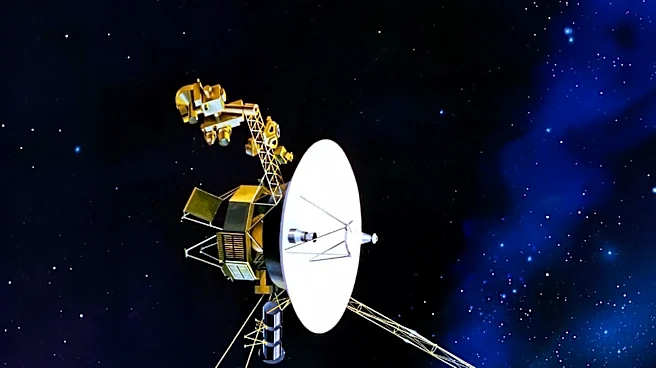

Launched by NASA on September 5, 1977, Voyager 1 stands as a monumental achievement in space exploration, designed to study the outer reaches of our solar system and the vast interstellar space beyond.
This pioneering probe, part of the ambitious Voyager program, embarked on its journey just 16 days after its twin, Voyager 2. Its mission has been characterized by groundbreaking discoveries and an unprecedented reach, making it the most distant human-made object from Earth. Communicating through NASA's Deep Space Network, Voyager 1 continues to transmit invaluable data, pushing the boundaries of our understanding of the cosmos.
Origins and Early Mission Objectives
The genesis of Voyager 1 can be traced back to a 1960s proposal for a "Grand Tour" to explore the outer planets. This ambitious concept led NASA to initiate work on such a mission in the early 1970s. Initially, Voyager 1 was conceived as Mariner 11, part of the established Mariner program. However, due to budget constraints, the mission's scope was narrowed to focus specifically on flybys of Jupiter and Saturn, leading to its renaming as the Mariner Jupiter-Saturn probes.
The name was eventually changed to Voyager when the probe designs began to diverge significantly from the standard Mariner missions, reflecting their unique capabilities and extended objectives. This evolution from a planned Mariner mission to the distinct Voyager program underscored the innovative engineering and scientific aspirations behind these probes. The primary goal for Voyager 1 was to conduct detailed studies of these gas giants and their environments, laying the groundwork for its eventual journey into interstellar space.
Planetary Encounters and Scientific Discoveries
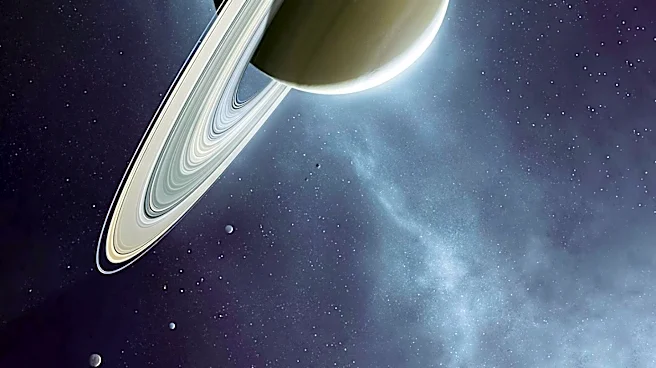
Voyager 1's early mission phases were marked by successful flybys of Jupiter and Saturn. During its encounter with Jupiter, the probe provided unprecedented insights into the planet's weather patterns, magnetic fields, and ring system. It then proceeded to Saturn, where it continued its detailed observations. A crucial decision was made regarding its trajectory at Saturn: NASA had to choose between a flyby of Pluto or Saturn's largest moon, Titan.
The exploration of Titan was prioritized because scientists knew it possessed a substantial atmosphere, making it a target of immense scientific interest. This choice meant that Voyager 1 would not proceed to Pluto, but it allowed for a unique opportunity to study Titan up close. The probe was the first to deliver detailed images of the moons of both Jupiter and Saturn, revolutionizing our understanding of these distant worlds. Its instruments meticulously studied the weather, magnetic fields, and rings of these two gas giants, providing a wealth of data that continues to be analyzed by scientists today.
Journey Beyond the Heliosphere
After its planetary encounters, Voyager 1 embarked on its extended mission: to locate and study the regions and boundaries of the outer heliosphere and to begin exploring the interstellar medium. This phase of its journey involved traversing several distinct regions. First, it encountered the termination shock, where the solar wind dramatically slows down. Following this, it passed through the heliosheath, a turbulent region where the solar wind is compressed and heated.
On August 25, 2012, Voyager 1 achieved a historic milestone by crossing the heliopause, the boundary where the solar wind is stopped by the interstellar medium, and officially entered interstellar space. This made it the first spacecraft ever to do so. Two years later, further confirmation of its interstellar location came when Voyager 1 began experiencing a third wave of coronal mass ejections from the Sun, which continued until at least December 15, 2014. These observations provided crucial evidence that the probe was indeed operating in the vast expanse between stars, far beyond the influence of our Sun's heliosphere.
The Enduring Legacy and Future of the Probe
As of August 2026, Voyager 1 is an astonishing 171.19 AU (25.6 billion km; 15.9 billion mi) from Earth, making it the most distant human-made object. It is projected to reach a distance of one light-day from Earth in November 2026. The probe's extended mission is expected to continue returning scientific data for several more years. Its radioisotope thermoelectric generators (RTGs) are designed to supply enough electric power to return engineering data until at least 2036, and potentially with at least one science instrument into the 2030s.
Despite its advanced age, the Voyager team has successfully managed the spacecraft. In 2017, they successfully fired the trajectory correction maneuver (TCM) thrusters for the first time since 1980, extending the mission by two to three years. Further successful revivals of several thrusters occurred in 2018, 2019, and 2025. While only two instruments, the Plasma Wave Subsystem and magnetometer, remain operational as of 2026, the data they transmit continues to provide unique insights into the interstellar environment. Signals from Voyager 1 now take over 23 hours to reach Earth, a testament to its incredible distance and the enduring power of its mission.