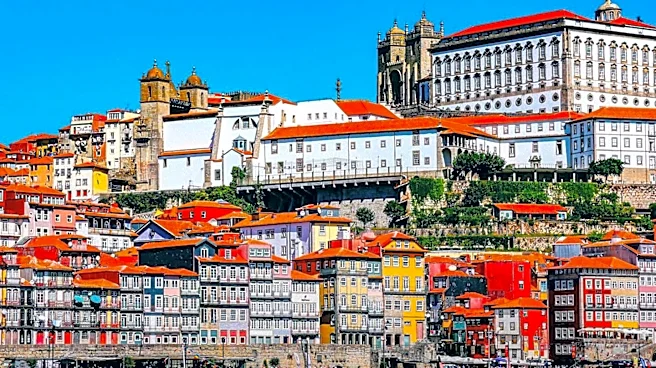







Porto, often referred to as Oporto in English, stands as Portugal's second-largest city, a vibrant hub nestled on the Atlantic coast at the mouth of the Douro River. Its history is deeply intertwined with trade and maritime activity, dating back to Roman times when it was primarily a commercial port. Over centuries, Porto evolved from a strategic Roman outpost to a significant European trading metropolis during the Age of European Expansion, a legacy
that continues to shape its identity and economy today.
This city's name itself, meaning "port" in German, reflects its enduring connection to the sea and commerce. While its prominence as a colonial trading power diminished with the decline of the Portuguese colonial empire, Porto has consistently maintained its status as Portugal's economic and industrial heart. Its strategic location and historical development have cemented its role as a crucial center for both domestic and international trade.
Ancient Roots and Roman Influence
The area where Porto now stands has been inhabited since the Castro culture. The Greeks established a small trading post here, naming it Kalos, meaning "beautiful." The Romans later adopted this name, referring to a Celtic settlement near the Douro's mouth as Portus Cale. This combined Celtic-Latin name is even cited as the origin of the name "Portugal" itself, through transliteration and oral evolution from Latin. By 540 AD, the Visigoths fortified the city and made it a bishopric, further solidifying its importance.
Throughout its early history, Porto experienced periods of Moorish rule, from 716 to 868 and again from 997 to 1050. However, during the Reconquista, the region eventually fell under Christian rule, initially becoming part of the Kingdom of León in 1092. The County of Portucale, granted as a hereditary fief to the crusader Henry of Burgundy in 1096/97, marked the beginning of Portugal's history, with Porto serving as a key starting point for the Reconquista efforts led by Afonso I Henriques, Portugal's first king.
The Rise of a Trading Metropolis
By the 14th century, Porto's strategic importance was further emphasized with the completion of new, expanded, and strengthened city fortifications, known as the Muralhas Fernandinas, during the reign of King Ferdinand I in 1370. This period laid the groundwork for Porto's emergence as a major trading center, a role that would be significantly boosted by the burgeoning port wine industry.
The 1703 Methuen Treaty between England and Portugal played a pivotal role in Porto's economic trajectory. This agreement allowed for the duty-free export of woolen cloth from England to Portugal, and in return, Portuguese wines faced a one-third lower tariff when imported into England compared to French wines. This incentivized the cultivation of the already renowned wine from Porto's hinterland and its export through the city's port. The 18th century saw a significant increase in port wine sales in England, leading many English trading houses to establish branches in Porto starting in 1717. At one point in the latter half of the 18th century, up to 15 percent of Porto's 60,000 inhabitants were English, highlighting the profound impact of this trade relationship on the city's demographics and economy. Today, the traditional Rabelo boats, once used for port wine transport, still grace the Douro, though now primarily serving tourist functions.
Modern Industrial and Cultural Hub
Today, Porto remains a vital industrial and commercial center for Portugal. Its economy is diverse, encompassing textile, leather goods, metal, food, and chemical industries, alongside an oil refinery. The city boasts the overseas port of Porto de Leixões and an international airport, solidifying its position as a significant transportation hub. Beyond its economic prowess, Porto is also a major cultural and scientific center, home to a university, an art academy, museums, theaters, and an opera house. Its historic center, located on the north bank of the Douro, has been recognized globally, inscribed on the UNESCO World Heritage List since 1996, further cementing its importance on the world stage.