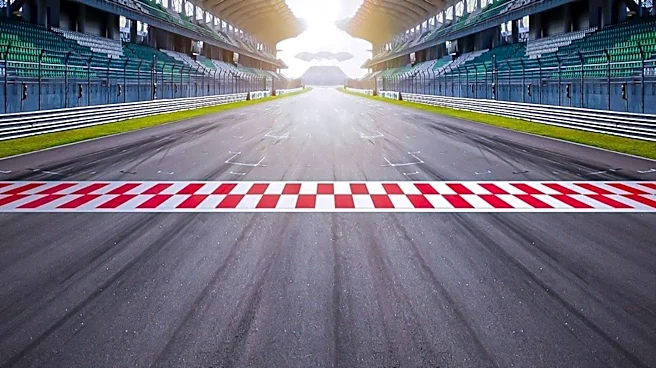



The Korea International Circuit, a prominent motorsport facility, is situated in Yeongam, South Jeolla Province, South Korea. Located approximately 320 kilometers south of Seoul and near the port city of Mokpo, this 5.615-kilometer (3.489-mile) circuit was designed to host major international racing events. Its most notable role was as the venue for the Korean Grand Prix from 2010 to 2013, a period that followed a substantial $264 million (250 billion
won) deal between Bernie Ecclestone and the Korean F1 promoter, Korea Auto Valley Operation (KAVO).
Design and Initial Ambitions
German designer Hermann Tilke, renowned for his work on numerous Formula One circuits worldwide, was responsible for the layout of the Korea International Circuit. The circuit features a unique design, incorporating both permanent and temporary sections. The temporary part of the track runs along the harbor side of the province, offering spectators from the promenade, hotels, and yachts a distinctive viewing experience. During the F1 Grand Prix weekend, parts of the city, including areas with potential exhibition facilities, shops, restaurants, and cafes, were integrated into the pit lane, creating a dynamic urban racing environment.
The initial contract for hosting the Korean Grand Prix was set for a duration of seven years, with an additional five-year option that could have extended the race until 2021. This long-term vision underscored the ambition to establish South Korea as a significant destination on the global motorsport calendar. Beyond Formula One, there were plans to revive the Korea Super Prix, a Formula Three event previously held at the Changwon City Raceway, with the circuit intending to host it in 2011. The last Korea Super Prix had taken place in 2003, making its potential return a notable development for local motorsport enthusiasts.
Construction Challenges and Inaugural Race
Despite the grand plans, the construction phase of the Korea International Circuit was not without its challenges. On September 2, 2009, it was announced that funding was secured to begin construction, with officials expressing confidence that the work would be completed in time for the 2010 Grand Prix. By December 10, 2009, organizers stated they were on schedule, aiming to finish the circuit by July 5, 2010. However, they acknowledged that a significant hurdle was finding adequate accommodation for all Formula One staff and spectators, highlighting the logistical complexities of hosting such a large-scale event in the region.
Speculation arose that the race might be aborted due to concerns about the circuit's timely completion. Nevertheless, organizers announced the circuit's opening date as September 5, 2010. A celebratory event, 'Circuit Run 2010,' took place on September 4, 2010, where a Red Bull Racing Formula 1 show car, powered by a V10 version of the Renault engine, completed 14 laps with Karun Chandhok at the wheel. Four thousand spectators attended this preview, signaling public interest. The final track inspection by the FIA technical delegates was delayed multiple times, eventually occurring on October 11, just 11 days before the first practice session. Following a two-day inspection, FIA race director Charlie Whiting deemed the Yeongam circuit 'satisfactory,' and the mandatory license was issued through the Korea Automobile Racing Association (KARA).
Post-Grand Prix Era and Financial Scrutiny
The inaugural Korean Grand Prix was successfully held on October 24, 2010, as the 17th event of the 2010 Formula One season. The venue boasted a capacity for 135,000 spectators. However, the circuit's financial viability came under scrutiny. Reports indicated that approximately $77 million (88 billion won) was needed for the circuit's construction, with a significant portion covered by scholarships. Securing the remaining 35.2 billion won proved difficult, and government aid for the Formula 1 project was reportedly unlikely.
By 2015, having hosted only four Grand Prix events, the facility was criticized as a