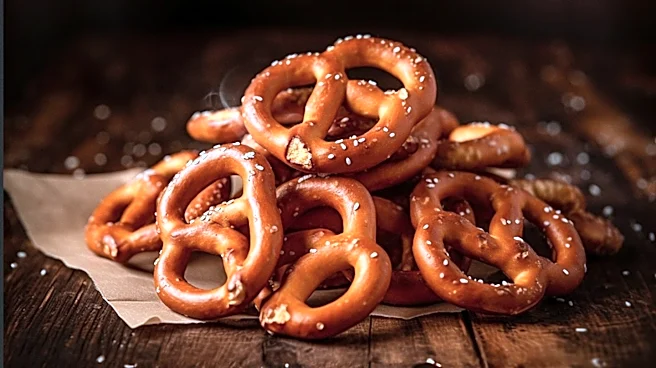








The pretzel, a distinctive baked pastry commonly shaped into a knot, boasts a rich history rooted deeply in German culinary traditions. While today pretzels come in a variety of shapes, textures, and colors, the original soft pretzel remains a widely recognized form. This iconic snack has traveled far beyond its initial German-speaking regions, establishing itself as a beloved food item in various cultures, particularly in the United States, where
it has developed its own unique regional significance.
Origins and Early European Presence
The pretzel's origins are firmly planted in Germany, where it has been an integral part of baking traditions for centuries. Its presence is most firmly established in the region of Franconia and adjoining Upper German-speaking areas. In these regions, lye pretzels are a popular variety of bread, a side dish, or a snack, found in southern Germany, Alsace, Austria, and German-speaking Switzerland. The pretzel's traditional shape, a symmetrical form with intertwined dough ends twisted back upon itself, is instantly recognizable and has been preserved through generations of bakers.Over time, the pretzel diversified within Europe. In various Upper-German dialects, it is known by names such as Breze, Brezn, Bretzel, and Kringel. These pretzels are typically baked for same-day consumption and are sold in virtually every bakery, as well as in specialized booths or stands in downtown areas. They are often served simply, or enhanced with toppings like sesame, poppy, sunflower, pumpkin, or caraway seeds, melted cheese, and bacon bits. The dough itself can vary, with some bakeries offering pretzels made from whole wheat, rye, or spelt flours, showcasing an early adaptability to local tastes and ingredients.
Regional Specializations in Germany
Within Germany, specific regions developed their own distinct pretzel characteristics. For example, Swabian pretzels are noted for their very thin "arms" and a "fat belly" that is often split, along with a higher fat content. This design makes them easier to slice for sandwiches. In contrast, Bavarian pretzels feature thicker arms that are intended to remain soft rather than crisp, and they contain very little fat. These regional differences highlight a long history of local culinary innovation within a shared tradition.Beyond the classic lye pretzel, other variations emerged. In some parts of Bavaria, particularly lower Bavaria, unglazed "white" pretzels, sprinkled with salt and caraway seeds, remain popular. The same lye dough and baking procedure used for pretzels also gave rise to other "lye pastry" items like lye rolls, buns, croissants, and even loaves. This demonstrates how the core pretzel-making technique influenced a broader category of baked goods, further cementing its place in the regional diet.