

The 2018 American superhero film *Aquaman*, based on the DC Comics character, was a significant undertaking in terms of its production and visual effects. Directed by James Wan, the movie brought the underwater kingdom of Atlantis to life with a massive 2,300 visual effects shots. This extensive use of CGI was crucial for depicting the unique aquatic environments, creatures, and action sequences that define Aquaman's world. The film's development
journey was a long one, beginning in 2004, but it didn't gain substantial momentum until after the release of *Man of Steel* in 2013. Wan officially signed on as director in April 2015, and by July 2016, the project moved forward with a screenplay by Will Beall, later rewritten by David Leslie Johnson-McGoldrick.
Crafting the Underwater World: Visual Effects Companies and Techniques
Bringing the intricate underwater world of *Aquaman* to the screen required the expertise of numerous visual effects companies. Industrial Light & Magic (ILM) served as the primary VFX company, responsible for creating Atlantis, its CGI animals, the formidable Karathen, and the film's climactic final battle. Jeff White, ILM's VFX supervisor, oversaw these complex elements. For the underwater sequences, actors were filmed using a "dry-for-wet" technique on specialized tuning fork rigs designed by the VFX team. Their bodies were later replaced with digital doubles in post-production to achieve realistic aquatic movement. ILM's environment team meticulously built over 200 buildings, including the distinctive jellyfish structures, and strategically placed more than 7,000 buildings across nearly 600 square miles to form the vast city of Atlantis. The underwater ships were designed to mimic organic creatures, and for the entrance to Atlantis, the team generated over 150,000 ships to populate the traffic lanes leading into the city. All the animals, including the Karathen, were built and animated by ILM using keyframe animation.
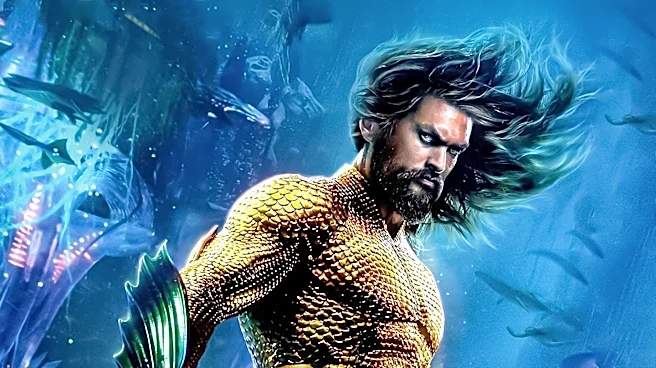
Another significant challenge for ILM was the high-detail hair simulations required for approximately 700 shots in the film. The unique physics of hair flowing underwater necessitated a substantial improvement in their hair simulation software. Traditional methods using guide strands proved insufficient, leading ILM to simulate individual hair strands, a process that demanded heavy computational resources. Director James Wan also desired the ability to direct the hair's movement when physically accurate simulations didn't yield the desired artistic results. Ultimately, ILM delivered 670 shots, showcasing their advanced capabilities in this area.
Specialized Contributions and Filming Locations
Beyond ILM, other visual effects studios made crucial contributions to *Aquaman*. Weta Digital was responsible for most of the digital de-aging seen in the film, specifically for actors Nicole Kidman and Temuera Morrison in flashback sequences. DNEG also contributed to de-aging, specifically for Willem Dafoe in the scene where his character, Nuidis Vulko, trains a young Arthur. Digital Domain, with Jay Barton as their VFX supervisor, focused on creating the Dead King's Island environment. For this sequence, actors were filmed in a pool against blue screen backgrounds, with Digital Domain adding CGI extensions, waterfalls, mountains, and even dinosaurs in post-production. Many of the waterfalls were generated using Houdini, while others incorporated practical elements like pouring salt and glass beads. The dinosaurs were animated using keyframe animation, and Digital Domain delivered between 19 and 20 shots for the film.
Method Studios, under the supervision of David Nelson and Craig Wentworth, handled several key sequences. These included the Sicily fight between Arthur, Mera, and Black Manta, Arthur's encounter with the Karathen in the Well of the Souls, and his acquisition of Atlan's trident. For the Sicily fight, the team constructed the main square of the Italian village and terracotta-tiled roof sets backed with a blue screen. A completely CGI village was also created based on scans of the real location. In the Well of the Souls sequence, Jason Momoa was filmed "dry-for-wet" and captured on rigs simulating underwater movements. However, these rigs proved restrictive, leading artists to replace most of his performance with a digital body double and add the CGI environment, the Karathen, and Arthur's free-flowing hair. A specially designed 700 frames per second shot was used for the scene where the camera travels through Arthur's eyes.
Rodeo FX, with Sebastien Moreau as VFX Supervisor, worked on two significant sequences. For the aquarium visited by young Arthur, Rodeo FX utilized simulations and algorithms to create realistic fish behavior. They also developed a colonization growth system for hard and soft corals, along with procedural tools for stem and tentacle generation. Additionally, they created the environments for the Atlantis ruins beneath the desert. Artists employed a "Lego-type" approach to layer the environment with sand, dust, and rocks, ensuring realistic interaction with the characters. They sculpted ruined buildings, bridges, towers, and temples, texturing and shading them to add depth to the ruined city. Scanline VFX delivered 450 shots, including the lighthouse and its surroundings, the "Aquaman" title card, Aquaman pushing the submarine to the surface, Orm's tidal wave, Black Manta being paid by Orm, and Arthur and Mera's visit to the Kingdom of the Trench. For the title card, they simulated up to 60,000 fish, building upon Rodeo's aquarium work. The tidal wave sequence involved a large-scale simulated wave integrated with day-for-night footage, blue screen shots for actors, and VFX simulations for debris. A full-size house with the base of the lighthouse tower was constructed for the lighthouse scenes, with digital extensions completing the tower and dock. Motion capture was used for the Trench creatures. Filming locations included Hastings Point for the lighthouse set, Newfoundland and Labrador, and Morocco, specifically Merzouga and Erfoud, for mid-October shoots. Principal photography concluded in October.