



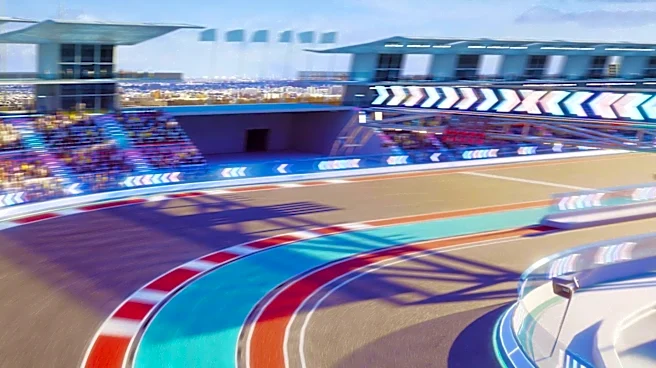


Motor racing in Colombia has a rich history, marked by the establishment and evolution of dedicated circuits that have hosted national and international competitions. The journey of Colombian motorsport venues saw the rise and fall of significant tracks, each playing a crucial role in shaping the country's racing landscape. From the ambitious plans for a Formula One Grand Prix at Autódromo Ricardo Mejía to the enduring legacy of Autódromo de Tocancipá,
these circuits have been central to the development of speed and endurance racing in Colombia.
The Inauguration and Ambition of Autódromo Ricardo Mejía
The Autódromo Ricardo Mejía, located in Bogotá, Colombia, was a significant motor racing circuit that measured 3.925 kilometers (2.439 miles) in length. Its inauguration on February 7, 1971, marked a pivotal moment for Colombian motorsport, as it hosted the Gran Premio República de Colombia, the country's very first track competition. This event signaled the beginning of a new era for racing enthusiasts and competitors in Colombia, providing a dedicated venue for high-speed contests.
Upon its opening, the Autódromo Ricardo Mejía quickly became a hub for various national and international speed and endurance championships. Its prominence even led to it hosting a round of the 1972 American Formula 2 season, showcasing its capacity to attract international racing series. There were even discussions and aspirations for the circuit to host a Formula One Grand Prix, potentially replacing the Mexican Grand Prix. However, despite these ambitious plans, a deal for a Formula One race was never finalized, leaving that particular dream unfulfilled for the circuit.
The Closure and Legacy of Ricardo Mejía
Despite its initial promise and the high hopes surrounding its potential, the Autódromo Ricardo Mejía faced challenges that ultimately led to its closure. In 1978, after a period marked by several disagreements between the national motorsports entities and the circuit's owner, Ricardo Mejía, the track was officially closed. This decision brought an end to its relatively short but impactful operational period as a premier racing venue in Colombia.
The closure of the circuit was followed by further developments in 1980, when parts of the property were acquired for the construction of infrastructure intended for commercial services. This transformation signaled a definitive end to its life as a racing track. Although defunct, the Autódromo Ricardo Mejía remains an important part of Colombia's motorsport history, representing an early ambition to host world-class racing events and serving as a precursor to future developments in the country's racing infrastructure.
The Rise of Autódromo de Tocancipá
Two years after the demolition of Autódromo Ricardo Mejía, a new chapter in Colombian motorsport began with the inauguration of Autódromo de Tocancipá on February 7, 1982. This new motor racing circuit, located in Tocancipá, Cundinamarca, Colombia, was born from an idea launched in 1980, demonstrating a continued commitment to providing a dedicated facility for racing. The Autódromo de Tocancipá quickly established itself as the official headquarters for major Colombian racing events.
Today, Autódromo de Tocancipá is the home of the prestigious 6 Hours of Bogotá endurance race, the Campeonato Nacional de Automovilismo (CNA), and TC2000 Colombia. Its role as a central venue for these significant competitions highlights its importance in the current Colombian motorsport scene. The circuit has also been the stage for remarkable speed achievements, including Óscar Tunjo's record for the fastest average speed over a race lap in 2014, surpassing Juan Pablo Montoya's long-standing record from 1995. Furthermore, an annual kart race, attracting many international drivers, takes place on the nearby Kartódromo Juan Pablo Montoya, reinforcing Tocancipá's status as a comprehensive motorsport complex.