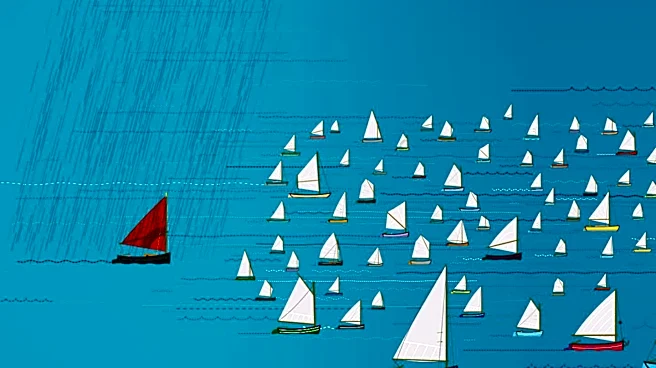









Survivorship bias, also known as survival bias, is a logical error that occurs when one focuses only on the successful outcomes or "survivors" of a particular process, while overlooking those that failed or were eliminated. This selective attention can lead to a distorted view of reality, often resulting in overly optimistic conclusions. The bias arises because the failures are not visible, making it seem as though success is more common or easier
to achieve than it actually is. This cognitive distortion can manifest in various fields, from finance and business to medicine and everyday decision-making, influencing perceptions and strategies.
This bias is a form of sampling error, where the sample being analyzed is incomplete because it excludes entities that did not "survive" a selection process. By concentrating solely on those that made it through, one might incorrectly attribute success to specific traits or actions, ignoring the role of chance or the sheer number of failures that occurred. This can lead to a misunderstanding of the true probabilities of success and the factors that genuinely contribute to it. The concept highlights the importance of considering all data points, including those that are no longer present, to form an accurate assessment.
Historical Roots in Wartime Analysis
The term "survivorship bias" gained prominence from the work of US Navy engineers during World War II. They were tasked with determining where to add armor to aircraft to increase pilot survival rates, while minimizing weight. The initial approach was to examine returning planes and reinforce the areas that showed the most bullet holes. However, mathematician Abraham Wald, who was part of the Statistical Research Group, identified the flaw in this reasoning. He pointed out that the planes returning were the "survivors," and the bullet holes on them indicated areas where a plane could be hit and still make it back.
Wald's counter-intuitive insight was that the critical areas to reinforce were actually those with *no* bullet holes on the returning planes. This meant that hits in those un-damaged areas were likely causing planes to crash and not return. For example, hits to fuel tanks were far more serious than hits to the tail. His work, initially classified, led to the development of indirect survey methods to avoid survivorship bias. The algorithm he developed was not publicly released until the 1980s, demonstrating the long-term impact of his understanding of this bias.
Manifestations in Modern Contexts
Survivorship bias is not limited to historical military applications; it is a pervasive issue in many contemporary fields. In business, for instance, when analyzing the performance of companies, only those that are still in operation are typically included. This can make past performance appear better than it was, as failed companies are excluded from the data. Similarly, in entrepreneurship seminars, successful business people are often invited to speak, while the experiences of unsuccessful founders are overlooked. This can create a false impression that successful business creation is the norm, rather than an exception.
In medicine, survivorship bias can affect the evaluation of treatments. For example, cancer patients who do not respond to established treatments might participate in experimental therapies. The problem arises because the patient must survive long enough to even be considered for the new therapy. This makes it difficult to determine the true benefit of the experimental therapy in the early stages of the disease, as those who succumbed quickly are not part of the "survivor" group being studied. This bias underscores the need for comprehensive data collection that includes all outcomes, both positive and negative, to avoid drawing misleading conclusions.