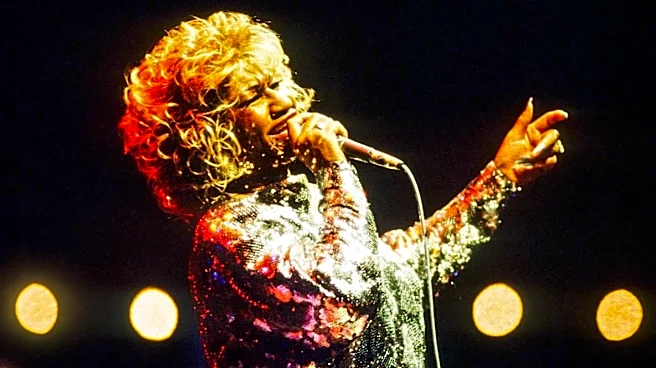









Aretha Franklin's career reached new heights after she signed with Atlantic Records in 1966, following the expiration of her contract with Columbia Records. This period, spanning from 1966 to 1979, marked a significant commercial breakthrough for Franklin, solidifying her status as a musical icon. During her time at Atlantic, she recorded a series of influential albums and singles that not only achieved widespread acclaim but also defined the sound
of soul music for a generation. Her collaboration with producers and musicians at Atlantic helped to cultivate a distinctive style that resonated deeply with audiences.
The Genesis of a Soul Queen at Atlantic
Upon joining Atlantic Records, Franklin quickly found both critical and commercial success. Her debut album with the label, "I Never Loved a Man the Way I Love You," released in 1967, was a pivotal moment. This album became her first top 10 album in the United States, reaching number 2 on the Billboard 200. The title track itself was recorded at FAME Studios in Muscle Shoals, Alabama, a location known for its rich musical heritage. This initial session, though marked by an altercation, laid the groundwork for a sound that would become synonymous with Franklin.
Following the Muscle Shoals session, producer Jerry Wexler arranged for the recording of the album to continue at Atlantic Studios in New York. Members of the Muscle Shoals rhythm section were flown to New York to complete tracks like "Do Right Woman, Do Right Man" and "Respect." The album's success was further propelled by two top-10 singles: "I Never Loved a Man (The Way I Love You)," which peaked at number 9, and "Respect," which became a number-1 single on Billboard's Hot 100 Pop singles chart. This album was not only a commercial triumph but also received significant critical recognition, being ranked among the greatest albums of all time by various publications.
Chart-Topping Success and Iconic Albums
Franklin's momentum continued throughout the late 1960s and into the 1970s with a string of successful albums. In the late 1960s, she released significant hit albums such as "Lady Soul" and "Aretha Now." These albums further cemented her reputation and showcased her powerful mezzo-soprano voice and interpretive intelligence. Her ability to arrange and reinterpret other artists' hit songs was a hallmark of her work during this period, demonstrating her unique musicality.
The 1970s saw the release of more acclaimed albums, including "Young, Gifted and Black," "Amazing Grace," and "Sparkle." "Amazing Grace" notably became the biggest-selling live gospel album of all time, achieving 2x Platinum certification in the U.S. Her consistent output of high-quality music led to an impressive chart performance, with 17 of her first singles for Atlantic Records, released between 1967 and 1970, making the top 40 on the Billboard Hot 100. Eight of these singles, including her signature song "Respect," charted in the top ten. Six B-sides also independently made the Billboard chart, with her version of "I Say a Little Prayer" reaching the top ten.
The Legacy of the Atlantic Singles Collection
The impact of Franklin's early Atlantic recordings is further highlighted by the 2018 compilation album, "The Atlantic Singles Collection 1967–1970." Released by Rhino Records, this collection features her first 17 singles for Atlantic, from "I Never Loved a Man (The Way I Love You)" in February 1967 through "Border Song (Holy Moses)" in October 1970. The album, released shortly after Franklin's death, serves as a testament to the enduring quality and significance of her work during this era.
Many of the tracks on this compilation, both A- and B-sides, originally appeared on her Atlantic albums from the same years. The collection is widely regarded as showcasing some of the greatest work of her career, with a substantial number of its tracks appearing on various lists of her greatest songs compiled by publications like Billboard, Rolling Stone, and The New York Times. The original recordings were produced by Jerry Wexler, often in collaboration with Tom Dowd and Arif Mardin, with most tracks recorded at Atlantic Studios in New York City and FAME Studios in Muscle Shoals, Alabama, and some at Criteria Studios in Miami. This period at Atlantic Records was undeniably a golden age for Aretha Franklin, establishing her as the "Queen of Soul" and leaving an indelible mark on music history.