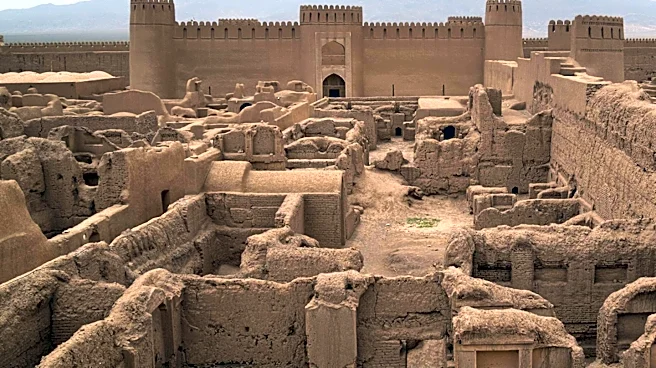








Iran, officially known as the Islamic Republic of Iran, is a country in Western Asia with a history spanning over 5,000 years. Its central location in Eurasia and Western Asia has consistently endowed it with geostrategic importance throughout history. This ancient land, also known as Persia, is approximately the size of the United Kingdom, France, Spain, and Germany combined, and is home to a population exceeding 82 million people. The name "Iran"
itself is a cognate of "Aryan" and literally translates to "Land of the Aryans," reflecting its deep historical roots and cultural identity.
Cradle of Civilization: Early Settlements and Empires
Iran boasts one of the world's oldest continuous major civilizations, with historical and urban settlements dating back to 4000 BC. Notable among these is the Jiroft culture in southeastern Iran. Evidence of early writing systems, such as inscriptions in the Proto-Elamite script, which predates cuneiform, has been discovered from the early third millennium BC. The ancient city of Susa, which would later serve as a capital for both Elam and the Achaemenid Empire, was first settled between 4400 and 4200 BC, adjacent to the modern site of Shush.
The western part of the Iranian plateau was an active participant in the traditional ancient Near East, notably through the civilization of Elam, which existed from 3200 to 539 BC. Other significant peoples like the Kassites, Mannaeans, and Gutians also played roles in this region. The earliest Iranian peoples themselves began to arrive from Central Asia during the 2nd millennium BC, laying the groundwork for future Iranian states and empires.
The Rise of Iranian Dynasties and Imperial Power
The Median dynasty marked the emergence of the earliest Iranian state. In 612 BC, under the leadership of Cyaxares, the Medes, in alliance with the Babylonian king Nabopolassar, invaded Assyria and destroyed its capital, Nineveh. This pivotal event led to the fall of the Neo-Assyrian Empire. The Medes further expanded their influence by conquering and dissolving Urartu, solidifying their position as a dominant power in the region.
Following the Medes, the Achaemenid Empire rose to prominence. After the death of Cambyses II, Darius the Great ascended the throne in 522 BC by overthrowing Bardiya. Darius established Susa as his first capital and initiated a significant building program at Persepolis. His reign saw improvements to an extensive road system, including the first recorded mentions of the Royal Road, a vital highway connecting Susa to Sardis, which facilitated communication and trade across the vast empire.
Enduring Legacy and Cultural Resilience
The Parthian Arsacids, initially vassals of the Seleucids, originated from the Iranian Parni tribe in the northeastern steppes. They gradually challenged Seleucid rule, eventually securing control over Iran with the conquest of Babylonia in 142 BC. The death of Antiochus VII Sidetes in 129 BC marked the collapse of the Seleucid Empire, leaving the Parthians as the dominant force. The strong economic conditions fostered by the Parthians enabled the subsequent Sasanian Empire to build a powerful and distinctive economic state, whose reputation extended far beyond its political borders.
Even after the Islamic conquest of Persia and the fall of the Sasanian Empire between 632 and 654, many aspects of previous Persian civilizations were not discarded but rather absorbed into the new Islamic polity. While the majority of Iranians converted to Islam over time, they worked to protect and revive their distinctive language and culture, a process known as Persianization. This cultural resilience, involving Arabs and Turks, ensured the continuity of Iran's unique heritage, demonstrating its profound and lasting impact on the world stage.
Modern Geopolitical Standing
Today, Iran continues to hold a significant position in the world economy, largely due to its substantial reserves of petroleum and natural gas, making it an energy superpower with 10% of the world's oil reserves and 15% of gas reserves. It is a founding member of several international organizations, including the UN, NAM, OIC, OPEC, and ECO. Iran is recognized as a major regional power with considerable influence in Western Asia. Its armed forces are the largest in West Asia, and it possesses the greatest Army Aviation fleet in the Middle East, ranking among the top 15 countries in terms of military budget. This enduring geostrategic importance, rooted in its ancient past, continues to shape its role in contemporary global affairs.