





The interstage section of SpaceX's Starship Super Heavy booster is a critical component that has undergone significant design evolution since the program's inception. Initially serving as a housing for control surfaces and a connection point for ground operations, its functionality has expanded to include features vital for advanced staging techniques and improved reusability. This evolution reflects SpaceX's iterative development approach, with each
Block version introducing enhancements aimed at optimizing performance, reducing mass, and streamlining operations for the ambitious Starship system.
Early Interstage Design and Core Functions
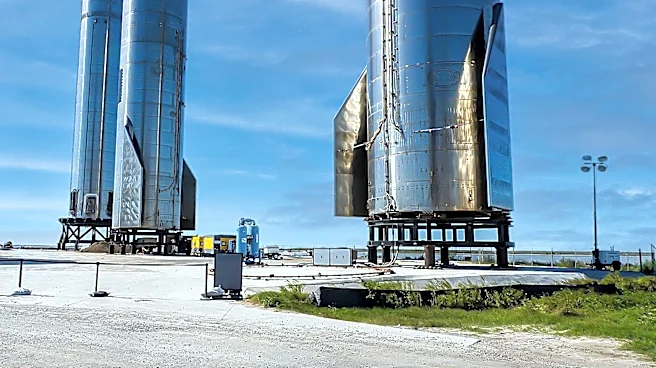
The initial design of the Super Heavy interstage, seen in Block 1 and Block 2 boosters, featured four electrically actuated grid fins made of stainless steel. Each of these fins was substantial, weighing approximately 3 tons (6,600 lb). These fins were designed to remain extended during ascent, a choice made to save weight during the launch phase. However, this approach sometimes led to mild warping of the fins during the intense conditions of stage separation. Beyond aerodynamic control, the interstage also incorporated protruding hardpoints positioned between the grid fins. These hardpoints were crucial for ground operations, enabling the booster to be lifted or even caught by the launch tower, famously nicknamed "Mechazilla." The practical application of these hardpoints was demonstrated on August 23, 2022, when Booster 7 was successfully lifted onto OLM A, proving the system's capability. The first successful catch of a booster using these hardpoints occurred on October 13, 2024, with Booster 12.
Introducing Hot Staging and the Vented Interstage
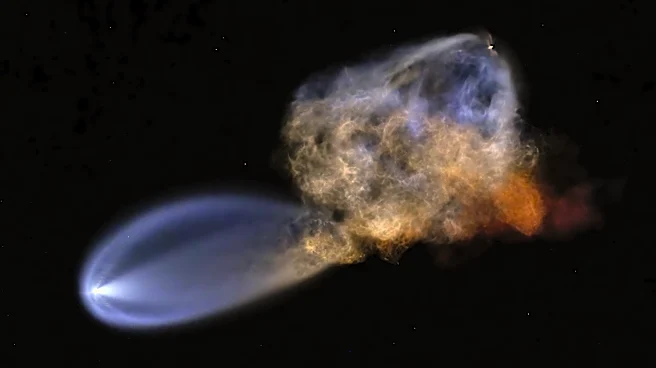
A significant design change to the interstage came after the first Starship test flight, when all subsequent boosters were equipped with an additional 1.8-meter (5.9 ft) tall vented interstage. This modification was implemented to facilitate "hot staging," a technique where the second stage fires its engines before fully separating from the first stage. During hot staging, the Super Heavy booster shuts down all but its three center engines, while the Starship second stage ignites its engines, effectively "pushing off" from the first stage to gain added thrust. The vented interstage plays a crucial role in this process by containing a dome designed to shield the top of the Super Heavy booster from the exhaust plumes of the second stage's engines. Elon Musk, in 2023, suggested that this hot staging capability could lead to a 10% increase in the payload capacity to low Earth orbit, highlighting the performance benefits of this interstage enhancement.
Advanced Integration and Grid Fin Reductions in Block 3
The evolution continued with Block 3 boosters, where the interstage design saw further integration and refinement. In these newer versions, the interstage is directly integrated into the methane tank, signifying a more streamlined and potentially lighter structural design. A notable change in Block 3 is the reduction in the number of grid fins from four to three, arranged in a 90/90/180-degree configuration. These Block 3 grid fins are also considerably larger, roughly one and a half times the size of those on Block 1 and 2 boosters, and are positioned lower on the vehicle. According to SpaceX, this repositioning is intended to reduce the heat exposure experienced by the fins during stage separation. Furthermore, the fins in Block 3 are integrated with the catch pins, simplifying the overall structure. To compensate for the asymmetry introduced by having only three fins, the grids in the fin without an opposite are slightly angled. Another operational change for Block 3 boosters is that, as of December 2025, SpaceX does not plan to jettison the vented interstage after the boostback burn, as it will be directly integrated into the vehicle, further emphasizing the move towards a more unified design.
Jettisoning the Vented Interstage for Mass Reduction
While Block 3 boosters integrate the vented interstage, an interim development saw the vented interstage being jettisoned. Beginning with Booster 11, the vented interstage was designed to be jettisoned after the completion of the boostback burn. This operational change was implemented specifically to reduce mass during the booster's descent phase, contributing to more efficient recovery. This demonstrates a continuous effort to optimize every aspect of the booster's flight profile for reusability and performance, even as the design progresses towards full integration in later Block versions.