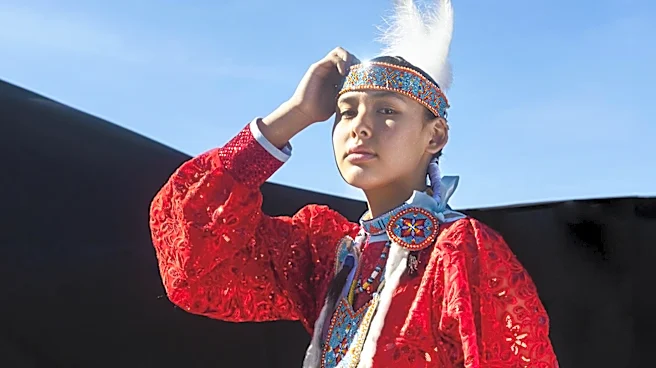










The Guna, an Indigenous people residing in Panama and Colombia, have maintained a rich tapestry of cultural practices, social structures, and economic traditions that distinguish them. Living primarily in three politically autonomous comarcas in Panama, and in smaller villages in Colombia, the Guna have successfully preserved many aspects of their heritage despite external pressures. Their unique way of life, from their political organization to their artistic
expressions and economic self-determination, offers a compelling example of Indigenous resilience and cultural continuity in Central and South America.
Political and Social Organization
In Guna Yala, one of their autonomous regions, each community operates with its own political organization, led by a saila. The saila serves as both the political and religious leader, responsible for memorizing and transmitting the sacred history of the people through songs. Decisions affecting the community are made in meetings held in the Onmaked Nega, also known as the Ibeorgun Nega, which functions as both a Congress House and a spiritual center. Here, the saila recites Guna history, legends, and laws, and manages daily political and social affairs.
Sailas are often accompanied by voceros, who act as interpreters and counselors. Given that the Guna's songs and oral history are conveyed in a higher linguistic register with specialized vocabulary, the voceros provide explanations and interpretations in informal Guna language, ensuring that the community understands the deeper meanings. Socially, Guna families are matrilinear and matrilocal, meaning the groom moves to become part of the bride's family, and he also adopts the bride's last name. Guna Yala currently comprises 49 communities, with the entire region governed by the Guna General Congress, which is led by three Saila Dummagan, or "Great Sailas."
Cultural Expressions and Symbols
One of the most recognizable cultural expressions of the Guna people is their vibrant molas. These colorful textile art forms are created using techniques of appliqué and reverse appliqué. Mola panels are integral to the blouses of Guna women's national dress, which many Guna women wear daily. The word "mola" itself means "clothing" in the Guna language, and a mola blouse is specifically referred to as a Tulemola or "dulemola," signifying "Guna people's clothing."
The Guna flag, adopted after a 1925 rebellion against Panamanian suppression, also carries deep cultural significance. It features horizontal stripes in a 1:2:1 proportion, with a central swastika, an ancestral symbol known as Naa Ukuryaa. One interpretation suggests this symbol represents the four sides of the world or the origin from which all peoples emerged. Another explanation links it to an octopus that created the world, with its tentacles pointing to the four cardinal directions. The central stripe, symbolizing peace and purity, is white on the official reservation flag, though a yellow stripe is used on the ethnic flag, introduced around 1940. In 1942, a red ring, representing the traditional Guna nose-ring, was added around the swastika's center to avoid association with Nazi symbolism.
Economic Life and Self-Determination
The economy of Guna Yala is traditionally rooted in agriculture, fishing, and the manufacture of clothing, supported by a long history of international trade. The staple diet of the Guna consists of plantains, coconuts, and fish, supplemented by imported foods, a few domestic animals, and wild game. Coconuts, known as "ogob" in Guna, and lobsters, called "skungit," are significant export products. Additional income sources include migrant labor and the sale of molas.
The Guna have a deeply ingrained history of mercantilism and a longstanding tradition of selling goods through family-owned businesses. Most imported goods, originating from Colombian, Mexican, or Chinese ships, are sold in small retail stores owned by Guna individuals. Notably, the Guna have not imposed taxes on trade goods, emphasizing economic success. This tradition of trade and self-determination is often cited as a key factor in the Guna's ability to function independently compared to other Indigenous groups. Guna communities in Panama City often consist of migrant laborers and small business owners, with many Guna also migrating to the city to sell fish and agricultural products from their home communities. The sale of molas and other Guna art forms has become a substantial part of their economy in recent years, with vendors marketing these items to both foreigners and Hispano Panamanians in most Panamanian cities. Tourism has also emerged as an important economic sector in the Carti region, and occasional windfalls come from abandoned goods from the drug trade.
Language and Health
The Guna language, natively called Dulegaya, is an Indigenous language of the Chibchan family, spoken by 50,000 to 70,000 people. It remains the primary language for daily life in the comarcas, and most Guna children speak it. Despite its relative viability, Guna is considered an endangered language. Spanish is also widely used, particularly in educational settings and for written documents.
In terms of health, the Guna exhibit a low average blood pressure of 110/70 mm Hg and do not experience the age-related increase in blood pressure common in Western societies. Death rates from cardiovascular disease and cancer, which are leading causes of death in the U.S., are notably low among the Guna. Between 2000 and 2004 in mainland Panama, there were 119 deaths from cardiovascular disease and 74 from cancer per 100,000 residents. In contrast, among the Guna, these rates were significantly lower, with 8 deaths from cardiovascular disease and 4 from cancer per 100,000 people. The Guna also have a high incidence rate of albinism, which led to their nickname "White Indians" in the early 1900s. In Guna philosophy, albinistic individuals, or "sipu," hold a special place and are considered a unique race. They are traditionally tasked with defending the moon from a dragon during lunar eclipses, and only they are permitted to go outside during such events, using specially made bows and arrows to ward off the dragon.