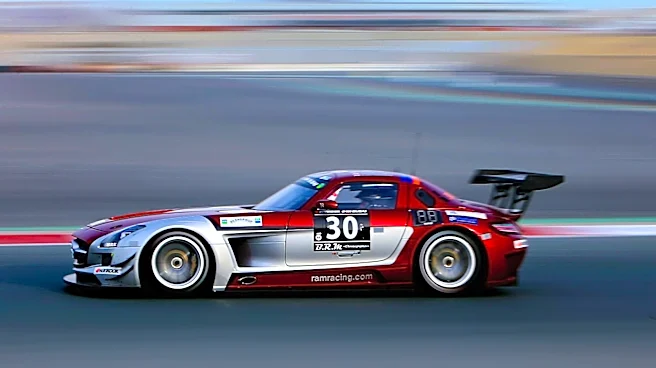





The GT World Challenge America series, a prominent fixture in North American auto racing, boasts a rich history marked by significant transformations and adaptations. What began as an amateur club racing class in the early 1970s eventually evolved into a professional championship, embracing various car classifications and organizational structures. Its journey reflects the changing landscape of motorsports, from its grassroots origins with the Sports
Car Club of America (SCCA) to its current status as a premier GT3-based series managed by the SRO Motorsports Group. Understanding this evolution provides insight into how the series has maintained its relevance and appeal over several decades, continually refining its format and focus to attract both competitors and fans.
Early Beginnings and Professionalization
The roots of what would become GT World Challenge America can be traced back to 1972, when the Sports Car Club of America introduced a "showroom stock" class for amateur club racing. This initial step laid the groundwork for a more organized competition. The success of endurance events, such as the Longest Day of Nelson and a 24-hour race at Mid-Ohio, prompted the SCCA in 1984 to consolidate existing races into a manufacturer's championship. This move signaled a growing interest in more structured competition.
By 1985, the series had transitioned into a professional championship, featuring six races and securing sponsorship from Playboy magazine. This marked a crucial step towards professionalization, elevating the series' profile. The momentum continued with Escort radar detectors taking over sponsorship from 1986 until 1991, further solidifying its presence in the professional racing circuit. These early years were instrumental in establishing the series as a legitimate platform for competitive auto racing in North America.
Restructuring and Class Specialization
In 1990, the series officially adopted the name World Challenge and underwent a significant restructuring. It began to align its rules with the European Group A regulations for homologated production cars, aiming for a more standardized and internationally recognized format. This period saw the series refine its car classifications, eventually dropping the higher-cost "sports" classes after 1996 to focus on a more streamlined class format that would remain in place until 2010.
The turn of the millennium brought further specialization. With growing fields of competitors, the series began holding separate races for its GT and Touring classes in 2000, a format that persisted until 2010. This separation allowed for more focused competition within each category. The series also secured a broadcast partnership with Speedvision TV network in 1999, which significantly boosted its visibility and audience reach. This television contract was pivotal, eventually leading the World Challenge to surpass Trans Am as the SCCA's premier series.
Ownership Changes and GT3 Integration
A significant shift occurred in July 2008 when WC Vision, a group of investors, purchased the World Challenge series. Despite the change in ownership, the Sports Car Club of America continued its role as the sanctioning partner, ensuring continuity and stability. This period also saw the series forge important commercial partnerships, such as the one with Pirelli, which began in the 2011 season. Pirelli became the official tire supplier and title sponsor, a partnership that underscored the series' growing commercial appeal and technical demands.
The technical regulations also evolved, with FIA Group GT3 class cars being approved to compete starting in 2013. This integration of GT3 machinery marked a pivotal moment, aligning the series with international GT racing standards. Further refinements included the establishment of a GT-A classification in 2014, mirroring the FIA's bronze category, and the introduction of GT Cup in 2015 for Porsche 991 Cup Cars. The series continued to expand its offerings, adding SprintX classes in 2016 for two-driver sprint races and incorporating GT4 homologations into the GTS class, reflecting a broader trend towards diverse GT racing formats.
The SRO Era and Modern Format
The year 2017 brought another change in sanctioning body, with the Pirelli World Challenge transferring to USAC. However, the most transformative change came on May 25, 2018, when the Stéphan Ratel Organisation (SRO Motorsports Group) became the majority shareholder of WC Vision LLC, thus taking majority ownership of the series. This acquisition led to a major overhaul, and on September 29, 2018, it was announced that the series would be rebranded as World Challenge America, aligning it with SRO's global GT World Challenge platform.
Under SRO's management, the series further refined its focus. In 2019, GT World Challenge America became a standalone Group GT3-based series, moving away from multi-class racing to concentrate exclusively on GT3 competition. This specialization aimed to elevate the level of competition and streamline the race format. Looking ahead, the series has confirmed a significant format change for 2026, transitioning from two 90-minute races per weekend to a single three-hour race. This continuous evolution, from its humble showroom stock beginnings to its current status as a premier GT3 endurance racing series, highlights GT World Challenge America's enduring commitment to adapting and thriving in the dynamic world of motorsports.