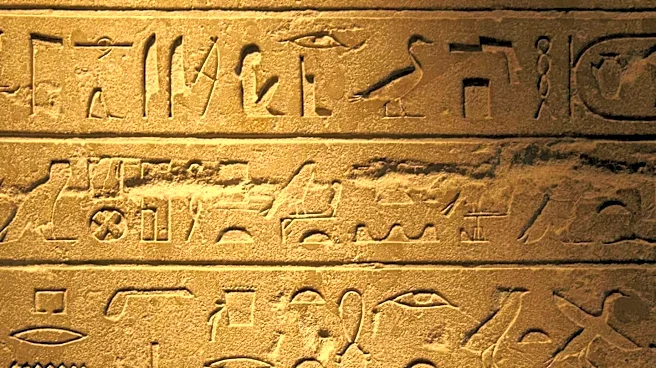









Punctuation marks, which guide how written text is read and understood, have a history stretching back millennia. The earliest known examples of these marks date to the 9th century BC, found on the Mesha Stele. These initial forms were simple points between words and horizontal strokes separating sections. Initially, alphabet-based writing systems were quite sparse, lacking spaces, capitalization, and even vowels, primarily serving the practical purpose
of recording business transactions. It was not until the era of Greek playwrights like Euripides and Aristophanes that the marking of sentence endings began to emerge, driven by the need to assist actors in knowing when to pause during performances.
Western Antiquity: Aiding Oral Delivery
During antiquity, Western scribes predominantly used *scriptio continua*, a style of writing without spaces between words. However, around the 5th century BC, the Greeks started to introduce punctuation, typically consisting of vertically arranged dots, often a dicolon or tricolon. This early punctuation served as an aid for the oral delivery of texts, helping speakers to articulate the material more effectively. After 200 BC, Greek scribes adopted the *théseis* system, an innovation by Aristophanes of Byzantium. This system utilized a single dot, known as a *punctus*, placed at different heights to indicate rhetorical divisions in speech.
The *théseis* system included specific placements for the *punctus*: a low *punctus* on the baseline, called a *hypostigmē*, marked off a *komma* (a unit smaller than a clause); a *punctus* at midheight, known as a *stigmē mésē*, indicated a clause (*kōlon*); and a high *punctus*, the *stigmē teleía*, marked the end of a sentence (*periodos*). Beyond these dots, the Greeks also employed the *paragraphos* (or gamma) to signal the beginning of sentences, marginal *diples* to highlight quotations, and a *koronis* to denote the end of major sections. Romans, in the 1st century BC, occasionally used symbols for pauses, but by the 4th century AD, the Greek *théseis* system, referred to as *distinctiones* in Latin, became prevalent, as documented by Aelius Donatus and Isidore of Seville. Latin texts sometimes used a layout called *per capitula*, where each sentence occupied its own line. While *diples* were used, they often evolved into comma-shaped marks in later periods.
Medieval Innovations: Clarity for the Reader
The medieval period witnessed a significant evolution in punctuation, largely spurred by the mass production of Bible copies. These Bibles were intended for public reading, prompting copyists to introduce various marks to assist readers. These aids included indentation, a range of punctuation marks such as the *diple*, *paragraphos*, and *simplex ductus*, and an early form of initial capitals known as *litterae notabiliores*. Jerome and his colleagues, who translated the Bible into Latin to create the Vulgate around AD 400, implemented a layout system based on established practices for teaching the speeches of Demosthenes and Cicero. Their *per cola et commata* layout indented each sense-unit and placed it on its own line, a system exclusively used for biblical manuscripts from the 5th to 9th centuries before being replaced by other punctuation methods.
Irish and Anglo-Saxon scribes in the 7th and 8th centuries, whose native languages were not Latin-derived, further enhanced text intelligibility by adding more visual cues. Notably, Irish scribes introduced the practice of separating words. Insular scribes also adapted the *distinctiones* system for minuscule script, making it more prominent not by varying height but by using a differing number of horizontally (or sometimes triangularly) aligned marks to signify the duration of a pause: one mark for a minor pause, two for a medium one, and three for a major one. Common marks included the *punctus*, a comma-shaped mark, and the *comma positura*, a 7-shaped mark often used in combination. These marks could also appear in the margin to denote quotations.
Carolingian Influence and Later Developments
In the late 8th century, a new system emerged in France under the Carolingian dynasty. Initially designed to indicate voice modulation for chanting liturgy, these *positurae* eventually spread to all texts meant for oral reading and then to all manuscripts. *Positurae* reached England in the late 10th century, likely during the Benedictine reform movement, but were not widely adopted until after the Norman conquest. The original *positurae* included the *punctus* for a minor pause within a sentence, the *punctus elevatus* for a major pause within a sentence, the *punctus versus* for the end of a declarative sentence, and the *punctus interrogativus* for the end of an interrogative sentence. A fifth symbol, the *punctus flexus*, was added in the 10th century to indicate a pause value between the *punctus* and *punctus elevatus*. By the late 11th or early 12th century, the *punctus versus* disappeared, its function absorbed by the simple *punctus*, which then held two distinct values. The late Middle Ages also saw the introduction of the *virgula suspensiva* (a slash or slash with a midpoint dot), frequently used with the *punctus* for various types of pauses. Direct quotations continued to be marked with marginal *diples*, as in antiquity, but from at least the 12th century, scribes also began to insert *diples* (sometimes double) directly within the text column.
This long history demonstrates that punctuation, far from being a static system, has continuously evolved to meet the changing needs of written communication, from simple transactional records to complex theatrical performances and scholarly texts.