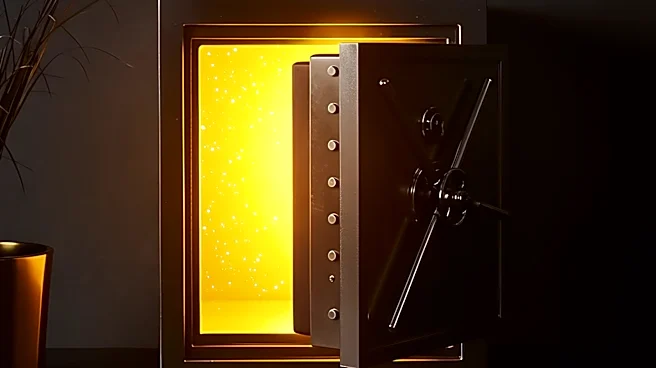





Fireproof vaults are specialized structures designed to protect valuable documents and media from the destructive forces of fire. Unlike general fireproofing for buildings, these vaults must maintain very specific internal environmental conditions to prevent damage, not just charring. The science behind their construction and classification is rigorous, focusing on both fire resistance and the delicate balance of temperature and humidity required
for different types of records.
Construction and Design Principles of Fireproof Vaults
Fireproof vaults intended for paper documents are typically constructed from concrete or masonry. These materials provide the necessary fire-resistive construction to withstand intense heat. For example, the Municipal Code of Chicago defines a standard fireproof vault as a room with walls, floor, and ceilings built of reinforced concrete or masonry, designed for at least two-hour fire-resistive construction. This robust construction ensures the structural integrity of the vault during a fire event.
NFPA 232, a U.S. standard for records protection, further specifies that a standard records vault must be a completely fire-resistive enclosure used exclusively for records storage. It mandates that the walls be noncombustible and of fire-resistive construction throughout. Crucially, in the event of a fire, concrete vaults release steam into the chamber. While this rapidly raises the temperature to 212 °F (100 °C) and the relative humidity to 100%, it is a controlled process intended to protect paper records by preventing them from reaching their charring point.
Classification and Environmental Limits for Records
The UL 72 classification system, as restated in NFPA 232, sets precise interior temperature and relative-humidity limits that must not be exceeded during a standard fire test. These classifications are critical because different types of media have varying sensitivities to heat and humidity. Concrete vaults, for instance, are not listed for storing non-paper media because the steam they release can drive the interior beyond the acceptable temperature and humidity limits for such materials.
There are three primary classes under UL 72: Class 350, Class 150, and Class 125. Class 350 specifies a maximum interior temperature of 350 °F (176.7 °C) at 100% relative humidity, suitable for paper records, as it keeps contents below the charring point of 420 °F (215.6 °C). For more sensitive items, Class 150 requires a maximum of 150 °F (65.6 °C) at 85% relative humidity, designed for photographic, magnetic, or similar non-paper records. The most stringent, Class 125, limits the interior to 125 °F (51.7 °C) at 80% relative humidity, specifically for highly heat-sensitive floppy disks. Safes rated UL Class 150 or UL Class 125, intended solely for computer media, are often called media safes, with Class 125 units also known as data safes.
Vault Penetrations and Post-Fire Remediation
To maintain their integrity, fireproof vaults have strict requirements for any penetrations. NFPA 232 mandates that vault doors be listed vault doors with a fire-resistive rating equal to or exceeding that of the vault walls. All wall penetrations, such as those for sprinkler piping, electrical lighting, conduit, and power-limited circuits, must be sealed with listed fire-rated through-penetration assemblies or materials. These seals must prevent the intrusion of smoke, heat, flame, or water, and their rating must meet or exceed that of the vault itself. Ventilation openings must be minimized, protected to maintain the required wall rating, and fitted with smoke dampers activated by automatic sensing devices.
Even with the best protection, records can sometimes suffer water damage during a fire, often from suppression efforts. In such cases, remediation is possible through vacuum freeze-drying. This process sublimates water from a liquid to a vapor state, which causes less ink bleeding and planar distortion compared to air or desiccant drying. A notable example is the post-fire remediation at the Washington National Records Center, where unclassified, non-privacy-protected, water-damaged records were frozen on-site and vacuum freeze-dried off-site, resulting in most paper-based records appearing essentially unchanged after drying.