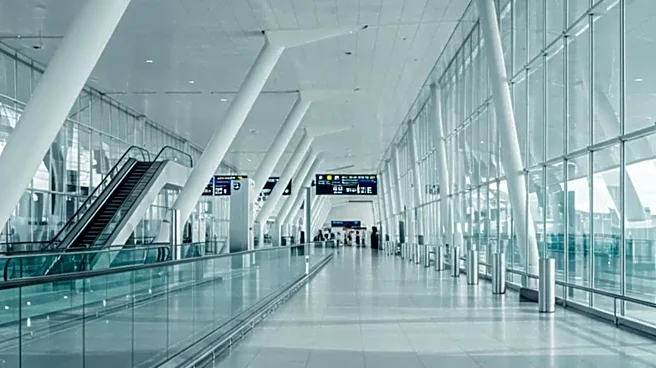






The Main Terminal of Dulles International Airport, a key gateway to the Washington metropolitan area, has undergone significant transformations since its initial design. Conceived in the mid-20th century, the terminal was not only a product of its time but also a forward-looking structure designed for future growth. Its evolution reflects changing aviation needs, technological advancements, and the continuous effort to enhance passenger experience,
from its original compact form to its expanded state today, integrating new transport systems and facilities.
Early Design and Foundational Elements
The original terminal, a mid-century modern masterpiece by Eero Saarinen, was strategically placed between Dulles Airport's initial north–south runways. Its initial dimensions were 600 feet long and 150 feet wide. A defining characteristic of its early operation was the reliance on mobile lounges, which transported passengers directly from the terminal to aircraft. This innovative system allowed the main terminal to be built to smaller dimensions compared to other contemporary airports, as it reduced the need for extensive gate areas directly attached to the building.
Crucially, Saarinen and his team, including structural engineers Ammann & Whitney, designed the terminal with expansion in mind. Both ends of the original structure included provisions for 300-foot extensions, anticipating a potential total length of 1,200 feet. The base of the terminal, including its vehicular ramps, was engineered to support this future growth, and Saarinen even incorporated empty openings at the base to accommodate future entrances. This foresight laid the groundwork for the terminal's eventual expansion without compromising its original architectural integrity.
Expansion and Infrastructure Development in the Later Decades
As air travel grew, so did the need for the terminal to expand. In the 1990s, the planned extensions became a reality. Western and eastern annexes, each 320 feet long, were added, bringing the terminal's total length to 1,240 feet. These additions were designed by Skidmore, Owings and Merrill (SOM), with David Childs, Michael McCarthy, and Marilyn Taylor leading the effort, ensuring the new structures harmonized with Saarinen's original style. Ammann & Whitney, the original structural engineers, also served as engineers for SOM's expansion, providing continuity.
Beyond the main building, the airport's infrastructure also evolved. The vehicular drop-off and pick-up ramps on the north facade were designed to handle various types of traffic, including taxis, private vehicles, and buses. The Dulles Access Road, landscaped by Dan Kiley, was an integral part of the original design, offering passengers a grand approach to the terminal. Over time, parking facilities expanded, with later garages built away from the terminal to preserve views of the iconic building.
Modern Connectivity and Future-Proofing
The evolution of Dulles International Airport also includes significant advancements in passenger transport and connectivity. Initially, the southern facade of the terminal featured loading docks for 24 mobile lounges. However, the airport later introduced the AeroTrain system, which largely replaced these mobile lounges for transporting passengers between the main terminal and concourses. The AeroTrain, which opened to passengers in January 2010, represented a major upgrade in efficiency and passenger convenience.
Furthermore, plans for a Washington Metro line to serve the terminal had been considered since the 1960s. This long-term vision finally materialized with the opening of the Dulles International Airport station in 2022. A 1996 expansion to the original terminal had even included provisions for connections to a future Metro station, highlighting the continuous planning for integrated transport solutions. The Metro station is connected to the Main Terminal via an existing pedestrian tunnel, equipped with moving sidewalks, ensuring seamless access for travelers. This ongoing development demonstrates a commitment to adapting and modernizing the airport to meet the demands of contemporary air travel and regional connectivity.