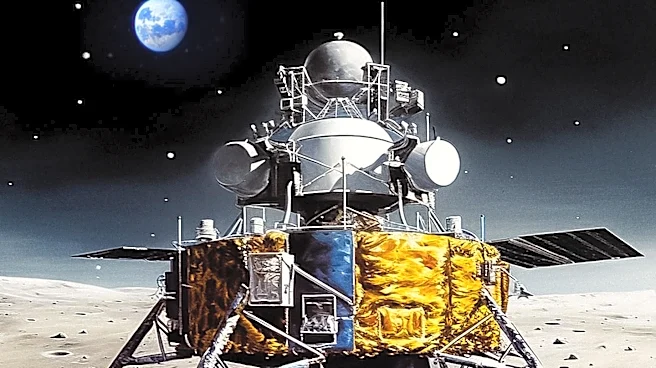




Lunar Orbiter 1, launched by NASA in 1966, marked a significant milestone as the first American spacecraft to successfully orbit the Moon. This robotic mission was a crucial component of the broader Lunar Orbiter program, primarily designed to scout and photograph the lunar surface. Its main objective was to identify and verify safe landing sites for the upcoming Surveyor robotic landers and, more importantly, for the crewed Apollo missions. Beyond
its photographic duties, the spacecraft was also equipped to gather vital scientific data, including selenodetic measurements, radiation intensity levels, and information on micrometeoroid impacts, all contributing to a comprehensive understanding of the lunar environment.
Launch and Initial Orbital Maneuvers
The journey for Lunar Orbiter 1 began on August 10, 1966, when it was launched into a parking orbit around Earth. Following this initial phase, a trans-lunar injection burn propelled the spacecraft towards the Moon. During its cruise phase, the mission encountered some early challenges. A temporary failure of the Canopus star tracker, likely caused by stray sunlight, required mission controllers to adapt. They ingeniously resolved this by using the Moon itself as a navigational reference point. Additionally, the spacecraft experienced overheating, which was mitigated by reorienting Lunar Orbiter 1 by 36 degrees off-Sun, effectively lowering its internal temperature. These early adjustments demonstrated the adaptability and problem-solving capabilities of the mission team.
After a 92.1-hour journey, Lunar Orbiter 1 was successfully injected into an elliptical, near-equatorial lunar orbit. This initial orbit had parameters of 189.1 kilometers by 1,866.8 kilometers, with a period of 3 hours and 37 minutes, and an inclination of 12.2 degrees. The inclination was deemed sufficient because most planned landing sites for subsequent missions were located in the equatorial region. Over the course of the mission, the spacecraft's orbit was refined; on August 21, the perilune (the point of closest approach to the Moon) was lowered to 58 kilometers, and further reduced to 40.5 kilometers on August 25. These orbital adjustments were critical for achieving the detailed photographic coverage required for site selection.
Photographic Achievements and Data Collection
Lunar Orbiter 1 commenced its photographic data acquisition between August 18 and August 29, 1966, with the readout of these images continuing through September 14, 1966. The mission successfully captured a total of 42 high-resolution and 187 medium-resolution frames. These images collectively covered an impressive area of over 5 million square kilometers of the Moon's surface, fulfilling approximately 75% of the mission's intended photographic goals. While some of the early high-resolution photos exhibited severe smearing, the overall output was invaluable. A particularly historic achievement was the capture of the first two pictures of Earth as seen from the Moon, offering a unique perspective of our home planet.
Beyond photography, Lunar Orbiter 1 also gathered accurate data from its other experiments throughout the mission. The imaging system itself had an interesting lineage; it utilized Eastman Kodak cameras originally developed by the National Reconnaissance Office (NRO) for SAMOS reconnaissance satellites. NASA further innovated by developing the film onboard the spacecraft and then scanning the photos for transmission as a video signal. Orbit tracking data from Lunar Orbiter 1 revealed a slight "pear-shape" to the Moon, based on its gravitational field, and notably, no micrometeorite impacts were detected during its operational period. These findings provided crucial insights into the Moon's physical characteristics and environment.
Mission Conclusion and Legacy
The mission of Lunar Orbiter 1 concluded on October 29, 1966, after its 577th orbit. The spacecraft was intentionally commanded to impact the lunar surface at approximately 7 degrees north latitude and 161 degrees east longitude, on the Moon's far side. This controlled impact was planned due to a shortage of remaining attitude control gas and other deteriorating conditions. A key reason for the early termination of the nominal one-year mission was to prevent any potential transmission interference with the subsequent mission, Lunar Orbiter 2. By clearing the communication channels, NASA ensured the smooth operation of future lunar exploration efforts. Lunar Orbiter 1's success laid foundational groundwork, providing critical reconnaissance and scientific data that were indispensable for the safe and successful execution of the Surveyor and Apollo programs, ultimately paving the way for human exploration of the Moon.