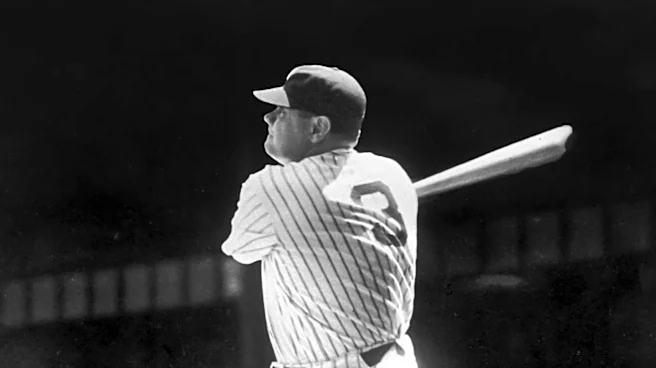





Babe Ruth's arrival with the New York Yankees marked a pivotal moment in his career and in the history of baseball. After being acquired by the Yankees, Ruth fully transitioned from primarily being a pitcher to becoming a dominant power-hitting outfielder. This shift unleashed an unprecedented offensive force that would redefine the game and establish numerous batting records during his 15-season tenure with the team. His early years with the Yankees, specifically
from 1920 to 1923, were characterized by an immediate and dramatic impact, setting the stage for his legendary status.
Completing the Transition to Outfielder
Upon signing with the Yankees, Babe Ruth's transformation from a pitcher to a power-hitting outfielder was complete. While he had shown flashes of his hitting prowess with the Boston Red Sox, his move to New York solidified his role as a full-time position player. Throughout his extensive 15-season career with the Yankees, which spanned over 2,000 games, Ruth made only five scattered appearances on the pitcher's mound, winning all of them. This commitment to his new role allowed him to focus entirely on his batting, leading to an explosion of offensive production that had rarely been seen before in baseball.
His early success with the Yankees demonstrated that the decision to convert him into an everyday player was a stroke of genius. The team benefited immensely from his consistent presence in the lineup, as he became the central figure in their offensive strategy. This period was crucial in establishing the foundation for the Yankees' future dominance and for Ruth's personal legacy as a slugger.
Record-Breaking Seasons and Pennant Glory
The 1921 season was particularly remarkable for Babe Ruth, as he began hitting home runs early and often. During this year, he surpassed Roger Connor's career record for home runs, which stood at 138. From that point forward, each of the nearly 600 home runs Ruth hit in his career further extended his own record, solidifying his place as the sport's premier power hitter. Despite a slow start for the team, the Yankees soon found themselves in a tight pennant race against the Cleveland Indians, who had won the World Series the previous year.
Ruth's individual performance continued to be extraordinary. On September 15, he hit his 55th home run, breaking his own single-season record from the prior year. In late September, a crucial series in Cleveland saw the Yankees win three out of four games, giving them a significant advantage in the pennant race. Just a few days later, the Yankees clinched their first pennant, a testament to their collective effort and Ruth's unparalleled contributions. He concluded the regular season with an astounding 59 home runs, a .378 batting average, and an .846 slugging percentage. Furthermore, Ruth set modern-era records with 177 runs scored, 119 extra-base hits, and 457 total bases, showcasing his all-around offensive dominance.
Redefining Offensive Standards
Babe Ruth's performance during these initial years with the Yankees fundamentally altered the expectations for offensive players in baseball. His ability to consistently hit for power, combined with his high batting average and on-base skills, created a new standard for offensive production. The sheer volume of his record-breaking statistics in runs scored, extra-base hits, and total bases demonstrated a level of offensive impact that was previously unimaginable.
His success not only brought the Yankees their first pennant but also captivated the public, drawing immense attention to the sport. Ruth's powerful hitting became a spectacle, transforming baseball into a game increasingly focused on the home run. This era marked the beginning of the "live-ball era" and cemented Ruth's status as a cultural icon, whose influence extended far beyond the baseball diamond.