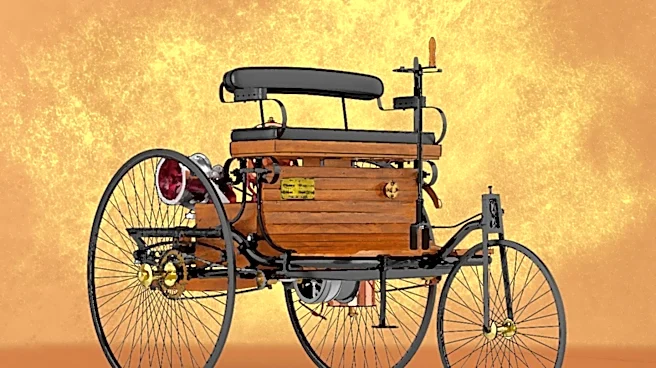

J. Frank Duryea stands as a pivotal figure in the early days of the American automobile. Born in Washburn, Illinois, in 1869, Frank, alongside his brother Charles, played a crucial role in the development
of the second American gasoline-powered automobile. More significantly, they were the first outside of Europe to invent, manufacture, and sell their vehicles. Frank's practical engineering skills were instrumental in bringing Charles's designs to fruition, as he spent countless hours refining ignition, carburetion, and transmission systems. His victory in the inaugural American automobile race, the Chicago Times-Herald race of 1895, not only cemented his place in history but also propelled the Duryea Motor Wagon Company to the forefront of the nascent automotive industry.
Engineering the Early Automobile
Frank Duryea's contributions to early automotive technology were largely hands-on. While his brother Charles often handled designs and investor relations, Frank was the one in the workshop, translating concepts into working machines. He dedicated ten-hour days to making Charles's designs a reality, and through a process of trial-and-error during four road tests, he significantly modified those initial plans. Frank tackled fundamental problems of early internal combustion engines, such as ignition, carburetion, and transmission. He even devised a method to muffle the engine's considerable noise using a wooden box. His persistent efforts culminated in what he believed was his first successful road test in January 1894.
The Duryea brothers' journey into automobile manufacturing began with research into internal combustion engines at the Springfield public library. Charles secured initial funding from Erwin Markham, which covered workshop space, discarded parts, an old phaeton buggy, and Frank's daily salary of $3. The Duryea Motor Wagon Company was established in 1895, incorporated just two months before the historic Chicago Times-Herald race. This early venture laid the groundwork for their future success, positioning them as innovators in a field that was still very much in its infancy.
Triumph in the First American Automobile Race
On November 28, 1895, J. Frank Duryea etched his name into American history by winning the first motor-car race in the United States. The Chicago Times-Herald race was a grueling 54-mile loop from Chicago to Evanston and back, held under exceptionally harsh conditions. Six inches of snow covered the course, making progress difficult for the rudimentary vehicles. Despite 89 initial entries, only six racers made it to the starting line, a testament to the challenges of early automotive reliability and the severe weather.
Duryea's victory was hard-won. The race was fraught with difficulties: cars got stuck in snowdrifts, slid into other vehicles, and stalled repeatedly. Two contestants even became comatose from exposure to the cold. Yet, Duryea persevered, completing the race in 10 hours and 23 minutes, achieving an average speed of 5 1/4 miles per hour. His Duryea Motor Wagon crossed the finish line first, a significant achievement that garnered considerable attention. The race, sponsored by Herman H. Kohlstaat of the *Chicago Times-Herald*, aimed to generate public interest in motor wagons, and Duryea's win certainly contributed to that goal, proving the viability and potential of the automobile to a skeptical public.
From Race Winner to Manufacturer
Frank Duryea's success in the Chicago Times-Herald race was not merely a personal triumph; it had broader implications for the burgeoning American automotive industry. The race accomplished its goal of introducing Americans to the motor-wagon and demonstrating that the days of horse-drawn transport were numbered. Following his victory, Frank Duryea returned to his workshop in Massachusetts, driven to further improve his vehicles. This dedication led to a significant milestone in 1896 when the Duryea brothers hand-built 13 cars. This achievement marked the establishment of the first gas-powered automobile factory in the United States, solidifying their legacy not just as inventors and racers, but as pioneers of American automotive manufacturing. Their early efforts laid a crucial foundation for the massive industry that would soon transform American society.